AI estimate as of July 7, 2025 · verify with a professional before acting
AI-Generated · Verify before acting
Everything on this page is generated by AI for informational purposes only. AI can make mistakes — the AI may misidentify items or misattribute them (artist, maker, brand, designer, origin, era). This is not an official valuation and should not be used for insurance, sale, tax, estate, legal, or lending purposes — or any decision requiring a certified appraisal. It is not an authoritative claim about any person, brand, or rights holder — do not share or rely on it as a factual statement about a third party. Always consult qualified professionals before making financial decisions.
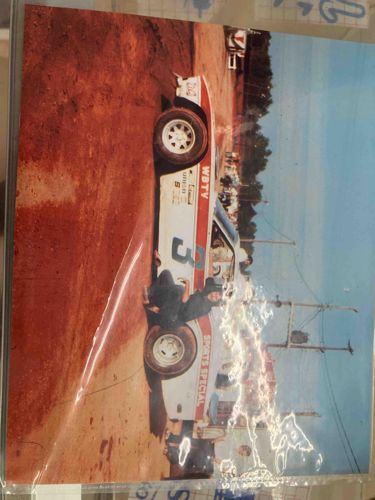
This item is a color photographic print depicting a dirt track race car, likely from a racing event. The photograph is oriented vertically, though the subject, a white stock car, is seen horizontally, suggesting it was captured while the car was in motion or positioned for a shot at a dirt track. The car itself is predominantly white with red and blue accents. It features the number '3' prominently on its side, in a large, dark font (possibly black or dark blue). Several sponsor logos are visible, including 'WBTN' in red lettering vertically along the side, and 'SPORTS SPECIAL' below it. Another smaller logo, 'Union 76' is also discernible near the front tire. The car appears to be a vintage model, possibly from the 1970s or 1980s, given its style and the overall aesthetic of the photograph. The background shows a reddish-brown dirt track surface, consistent with dirt track racing. In the distance, other vehicles or structures related to the racetrack are faintly visible against a light blue sky. The print itself shows signs of age and wear. It is encased in a clear plastic sleeve or laminate, which has caused significant glare and reflections across the surface, particularly in the lower right quadrant, obscuring some details. There are also visible scuffs and minor surface imperfections on the print and/or the protective layer. The colors appear somewhat faded but still retain their vibrancy. The image quality, while affected by wear and glare, suggests a standard photographic print of its era. No specific photographer's mark or printing details are immediately visible.
AI Appraisal Report
I have carefully examined the provided image of this color photographic print depicting a dirt track race car. Based on my visual assessment, the print appears to be a standard photographic print, likely from the 1970s or 1980s, consistent with the style of race car and visible sponsor logos. The condition, as observed through the image, shows signs of age and wear. The significant glare and reflections from the protective sleeve obscure details, particularly in the lower right, and there are visible scuffs and imperfections. The colors appear somewhat faded but still retain some vibrancy.
From a market perspective, photographs of generic dirt track race cars, even vintage ones, generally do not command high values unless connected to a historically significant event, a famous driver, or a renowned photographer. Without such provenance or artistic merit, demand is limited mainly to niche collectors of racing memorabilia or local racing enthusiasts who might recognize the specific car or track. Rarity is difficult to assess without knowing the photographer or print run, but similar candid shots from racing events are generally not rare.
Factors significantly impacting value here include the lack of identifiable historical significance of the car or driver, the generic nature of the image (not capturing a definitive race moment or artistic composition), and its fair condition with visible wear and glare issues. Were this an original press photograph with detailed captions, or a print by a known racing photographer, its value would be considerably higher.
It is crucial to note that authenticity verification from an image alone is limited. I cannot definitively confirm if this is an original period print or a later reproduction without physical examination. In-person examination would allow me to assess the paper type, photographic process, and true physical condition (e.g., presence of creases, fading not apparent through glare). Provenance documentation (e.g., photographer attribution, event details, print date) or scientific testing would be needed for full authentication and to ascertain any historical significance.