These notes were written by the person who submitted this item. Appraiser.AI has not verified them, and the AI's identification and estimate may rely on them.
AI Estimated Value
Not an official valuation
$150-250
AI estimate as of August 31, 2025 · verify with a professional before acting
AI-Generated · Verify before acting
Everything on this page is generated by AI for informational purposes only. AI can make mistakes — the AI may misidentify items or misattribute them (artist, maker, brand, designer, origin, era). This is not an official valuation and should not be used for insurance, sale, tax, estate, legal, or lending purposes — or any decision requiring a certified appraisal. It is not an authoritative claim about any person, brand, or rights holder — do not share or rely on it as a factual statement about a third party. Always consult qualified professionals before making financial decisions.
This analysis also relies on unverified notes provided by the user, which may be incomplete or inaccurate and could affect the result.
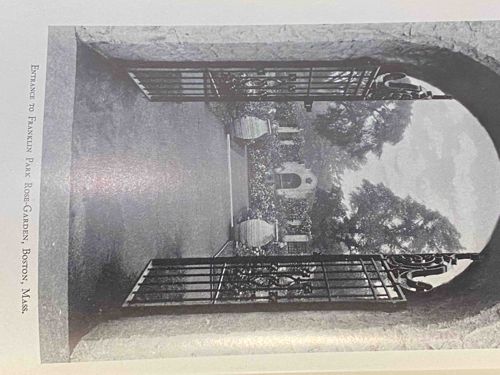
This item is a framed black and white photographic print depicting the "Entrance to Franklin Park Rose-Garden, Boston, Mass." The print is oriented vertically with the inscription along the left margin, running from bottom to top. The image itself captures a view through a large, arched stone entryway, revealing a glimpse of the rose garden beyond. Two ornate, possibly wrought-iron, gates are visible, partially open, with intricate scrollwork and a grid pattern. Through the gates, lush foliage, including mature trees and what appears to be a formal garden setting with a statue or fountain in the distance, can be seen under a somewhat hazy sky. The physical print exhibits a monochrome palette, characteristic of historical photography, with varying shades of gray, black, and white. The paper appears to have a slightly textured surface, indicative of older photographic printing techniques. There are no obvious signs of significant damage such as tears, creases, or substantial discoloration to the print itself, although some slight mottling or silvering, common with age, may be present in the darker areas. The framing component, though not entirely visible, suggests a simple, light-colored mat or frame edge at the bottom of the image, allowing the print to be the focal point. The clear textual inscription at the left provides a definitive location and indicates the print's historical context. Based on the photographic style and the nature of public park imagery, this print likely dates from the late 19th to early 20th century, representing a historical record of a specific landmark. The craftsmanship appears to be a standard photographic print of its era, intended for informational or souvenir purposes.
AI Appraisal Report
I have examined the provided image of the 'Entrance to Franklin Park Rose-Garden, Boston, Mass.' photographic print in its frame. Visually, the print exhibits good overall condition, with no obvious tears, creases, or major discoloration. The monochrome palette and textual inscription are consistent with turn-of-the-century photographs. The paper texture and potential slight mottling align with common aging characteristics for such prints. The framing appears simple and unobtrusive, which is generally favorable.
From a market perspective, historical photographic prints of local landmarks, particularly Boston, maintain a steady demand among collectors of local Americana, historical ephemera, and photography enthusiasts. While the subject matter is appealing, the print appears to be a commercially produced souvenir photograph rather than a fine art piece by a renowned photographer. Comparables for similar historical Boston landmark photographs of this era, without unique artistic merit or a famous photographer, typically fall within the $100-$300 range, depending on rarity, condition, and presentation (framing).
The primary factor impacting value is its historical rather than artistic significance. It's a nice historical record. Without physical inspection, I cannot definitively assess the exact printing process (e.g., silver gelatin, albumen), paper quality, or the presence of any subtle damage such as foxing, silvering in dark areas, or adhesive residue on the reverse. Full authenticity of the print's age and printing technique would ideally require in-person examination by a photography conservator, and provenance documentation (e.g., original sales receipts, family history) would further enhance verification.