AI estimate as of August 31, 2025 · verify with a professional before acting
AI-Generated · Verify before acting
Everything on this page is generated by AI for informational purposes only. AI can make mistakes — the AI may misidentify items or misattribute them (artist, maker, brand, designer, origin, era). This is not an official valuation and should not be used for insurance, sale, tax, estate, legal, or lending purposes — or any decision requiring a certified appraisal. It is not an authoritative claim about any person, brand, or rights holder — do not share or rely on it as a factual statement about a third party. Always consult qualified professionals before making financial decisions.
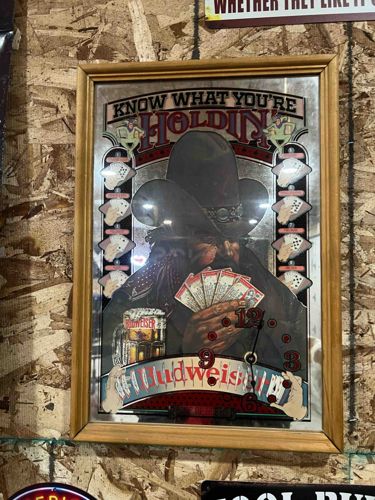
This is a vintage Budweiser advertising mirror with an integrated clock, likely dating from the late 20th century, possibly the 1980s or 1990s. The mirror features a central graphic of a cowboy or poker player with a large brimmed hat, holding a fan of playing cards. Below his hand, a frothy mug of Budweiser beer is depicted. The top of the mirror reads "KNOW WHAT YOU'RE HOLDIN'" in stylized text, with 'HOLDIN'' being particularly prominent and red. The Budweiser logo is clearly visible both on the beer mug and as a larger banner at the bottom center of the mirror. The mirror surface has silvered and colored graphics, with some areas appearing to be reverse-painted to achieve the desired imagery and text. The clock mechanism is integrated into the lower half of the mirror, with visible numerals 3, 6, 9, and 12, and smaller dots indicating other hours. The clock hands are visible against the graphic. The mirror is housed in a simple, rectangular wooden frame with a light, natural wood finish, possibly oak or pine. The overall dimensions appear to be roughly 2 feet in height by 1.5 feet in width, though exact measurements are not discernible. The visible condition shows some minor wear consistent with age and use, such as light scratching or dust on the mirror surface, and the frame shows no significant damage. The quality of craftsmanship is typical for mass-produced advertising items of its era, intended for commercial or home bar use, and it blends both decorative and functional elements. The reflective surface also shows some glare from the surrounding environment, typical of mirrors. The unique aspect is the combination of a brand advertisement with a functional timepiece, making it a desirable piece for collectors of brewery memorabilia or Americana.
AI Appraisal Report
Based on my visual examination, this Vintage Budweiser “Know What You’re Holdin’” Advertising Mirror Clock appears to be an authentic mass-produced promotional item from the late 20th century, likely the 1980s or 1990s. The graphics, font, and overall design are consistent with Budweiser's advertising campaigns of that era. Its condition, as perceived from the image, is good, showing only minor wear such as light surface scratching or dust, which is typical for an item of this age. The wooden frame also appears intact. The functionality of the clock cannot be verified without physical inspection; a non-functional clock mechanism would slightly reduce its top-end value.
In terms of market conditions, vintage advertising mirrors, especially those from popular brands like Budweiser, retain a steady but not exceptionally high demand. They are common collectibles, often appealing to bar decor enthusiasts, brewery memorabilia collectors, and those seeking nostalgic items. While the "Know What You're Holdin'" theme is recognizable, items of this specific design are not exceptionally rare. Comparables for similar vintage Budweiser mirror clocks typically sell in the $100-$200 range, with pristine examples fetching closer to the upper end, and those with more significant wear or non-functional parts falling lower. The combination of decorative and functional elements adds to its desirability.
Factors impacting value include its good visual condition and desirable brand. However, its mass-produced nature and relative commonality prevent it from reaching higher values. For full authentication and a definitive appraisal, an in-person examination would be crucial to assess the true condition of the mirror surface (e.g., hazing, silver loss), verify the clock's operation, and determine if any repairs or alterations have been made. Provenance documentation, while helpful, is not typically available for such common advertising items.