AI estimate as of September 17, 2025 · verify with a professional before acting
AI-Generated · Verify before acting
Everything on this page is generated by AI for informational purposes only. AI can make mistakes — the AI may misidentify items or misattribute them (artist, maker, brand, designer, origin, era). This is not an official valuation and should not be used for insurance, sale, tax, estate, legal, or lending purposes — or any decision requiring a certified appraisal. It is not an authoritative claim about any person, brand, or rights holder — do not share or rely on it as a factual statement about a third party. Always consult qualified professionals before making financial decisions.
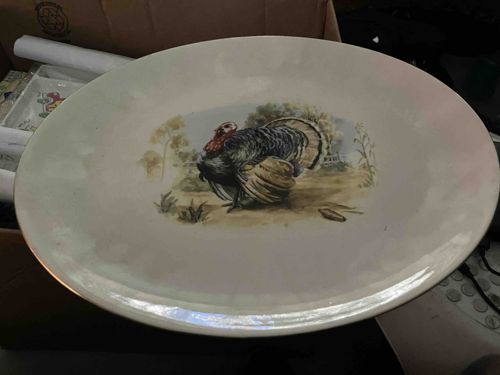
This is an oval-shaped ceramic serving platter, likely made of earthenware or porcelain, featuring a central hand-painted or transfer-printed depiction of a turkey. The platter has a slightly raised rim and a gently sloping well. The primary color of the ceramic is an off-white or cream, indicating it may be an older piece or a specific type of ceramic. The turkey illustration is detailed, showing a mature male turkey with iridescent black and brown plumage, a prominent fan tail, and a red wattle and snood. It appears to be standing in a pastoral setting with sparse trees or bushes in the background and some stylized foliage in the foreground. The colors used for the turkey are rich and earthy, including shades of brown, black, blue, and red, with hints of yellow and green for the landscape. There are visible signs of wear, particularly around the edges of the platter, where the glaze appears to be thinning or scuffed, and there are some darker marks or discolorations on the cream-colored surface, suggesting age and regular use. No specific maker's marks or signatures are visible from the provided image, but the style of illustration and the general aesthetic suggest a late 19th to mid-20th century production, possibly for holiday serving, such as Thanksgiving. The overall craftsmanship suggests a mass-produced item rather than bespoke studio pottery, but the detailed decoration indicates a certain level of quality for its time.
AI Appraisal Report
I have examined the provided image of this oval ceramic platter featuring a turkey decoration. The platter appears to be made of earthenware or porcelain, with an off-white/cream primary color typical of pieces from the late 19th to mid-20th century. The central turkey motif, with its detailed plumage and pastoral setting, strongly suggests a holiday-themed serving piece, likely for Thanksgiving. This style of decoration was popular for mass-produced dinnerware during that era.
Condition-wise, I note visible signs of wear, particularly around the edges where the glaze appears thin or scuffed. There are also darker marks and discolorations on the surface, indicating age and regular use. These minor imperfections are consistent with a well-loved utilitarian object of its age and do not significantly detract from its overall appeal, though pristine condition would command a higher price.
From a market perspective, these types of turkey platters are relatively common, especially around holiday seasons. While desirable for their nostalgic appeal and functional utility, they are rarely rare or highly sought after by serious collectors unless associated with a particularly renowned maker or exceptional design. Given the mass-produced nature and lack of visible maker's marks, it falls into a decorative, collectible category rather than fine art ceramics. Comparables for similar vintage turkey platters typically range between $30 and $80, depending on condition, size, and specific decoration quality.
The primary factor impacting value here is its decorative and nostalgic appeal for holiday use, coupled with its good, albeit used, condition. Without an in-person examination, I cannot definitively determine the exact ceramic type (e.g., earthenware vs. porcelain) or verify any maker's marks that might be obscured or on the underside. A physical inspection would also allow for a more thorough assessment of crazing, chips, or repairs, and provenance documentation would be needed to establish any unique historical significance. Based on the visual evidence, I estimate the appraisal value to be $40-70.