AI estimate as of December 5, 2025 · verify with a professional before acting
AI-Generated · Verify before acting
Everything on this page is generated by AI for informational purposes only. AI can make mistakes — the AI may misidentify items or misattribute them (artist, maker, brand, designer, origin, era). This is not an official valuation and should not be used for insurance, sale, tax, estate, legal, or lending purposes — or any decision requiring a certified appraisal. It is not an authoritative claim about any person, brand, or rights holder — do not share or rely on it as a factual statement about a third party. Always consult qualified professionals before making financial decisions.
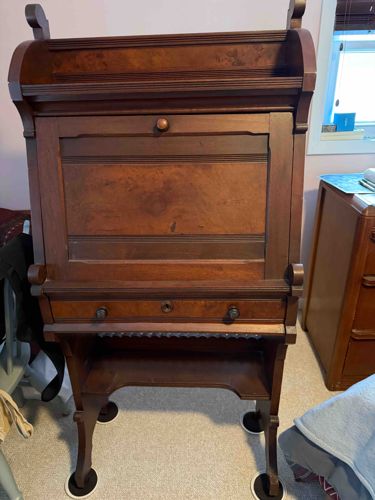
This is a Victorian-era secretary desk, also known as a fall-front desk, crafted from dark-stained wood, likely oak or mahogany given its characteristic grain patterns. The desk features a prominent fall-front panel that, when opened, would typically reveal a writing surface and interior compartments. The panel itself displays a rich, burled wood veneer or distinct graining at its center, framed by solid wood stiles and rails with a recessed panel design. Above the fall front, there is a small central brass knob, possibly for opening a shallow drawer or simply decorative. The top section of the desk features a serpentine or rounded crest rail with carved accents at the side supports, adding a decorative flourish. Below the main fall-front section, there is a single, narrow drawer with two brass or dark-finished wooden pulls and a keyhole at its center, indicating it is likely lockable. Beneath this drawer, a scalloped or carved trim piece adds an additional layer of ornamentation. The desk stands on four turned legs, which transition into flattened, splayed feet, resting on white protective pads. A lower shelf connects the front and back legs, providing additional storage or display space. The overall finish appears to be a deep reddish-brown, with some visible wear and minor staining on the fall-front panel, suggesting age and consistent use. The piece exhibits characteristics of late 19th-century or early 20th-century furniture design, leaning towards a Late Victorian or Edwardian aesthetic due to its elaborate yet somewhat restrained carving and functional design. The construction appears solid, indicative of traditional woodworking techniques, although specific joinery is not visible. The patina across the piece suggests original finish that has aged naturally over time, contributing to its antique character.
AI Appraisal Report
I have examined this Victorian-era secretary desk, or fall-front desk, through the provided image. The piece appears to be constructed from a dark-stained wood, likely oak or mahogany, exhibiting typical late 19th to early 20th-century design characteristics. Its 'Late Victorian' to 'Edwardian' aesthetic is evidenced by the serpentine crest rail, carved accents, turned legs, and scalloped trim. The fall-front panel with its burled veneer and the single drawer below both contribute to its functional design.
Condition-wise, the visible wear and minor staining on the fall-front panel suggest a natural aging process and consistent use, which is desirable in antique furniture as it indicates authenticity and a well-preserved original finish. The overall structure appears solid, and the visible patina supports the likelihood of an original finish. The brass hardware, while small, is consistent with the period.
Market conditions for such pieces are stable. While not exceptionally rare, well-preserved functional antique furniture like this desk retains a steady demand. Comparable sales of similar fall-front secretary desks from the Victorian or Edwardian periods, especially those with attractive styling and in good, original condition, typically fall within this range. The presence of a lower shelf is a nice practical addition, enhancing its appeal.
Factors impacting value positively include its apparent originality, good structural integrity, and desirable historical period. The minor wear is typical and does not detract from its value. Limitations in authenticity verification from an image alone are significant; I cannot definitively confirm wood species, original finish, or rule out repairs. An in-person examination would be crucial to inspect joinery, internal compartments for restoration, verify hardware originality, and assess the extent of any repairs or alterations. Provenance documentation would further solidify its history and authenticity. Without this, I must base my assessment primarily on visual aesthetics and typical construction methods of the era visible in the image.