These notes were written by the person who submitted this item. Appraiser.AI has not verified them, and the AI's identification and estimate may rely on them.
AI Estimated Value
Not an official valuation
$800-1,200
AI estimate as of September 23, 2025 · verify with a professional before acting
AI-Generated · Verify before acting
Everything on this page is generated by AI for informational purposes only. AI can make mistakes — the AI may misidentify items or misattribute them (artist, maker, brand, designer, origin, era). This is not an official valuation and should not be used for insurance, sale, tax, estate, legal, or lending purposes — or any decision requiring a certified appraisal. It is not an authoritative claim about any person, brand, or rights holder — do not share or rely on it as a factual statement about a third party. Always consult qualified professionals before making financial decisions.
This analysis also relies on unverified notes provided by the user, which may be incomplete or inaccurate and could affect the result.
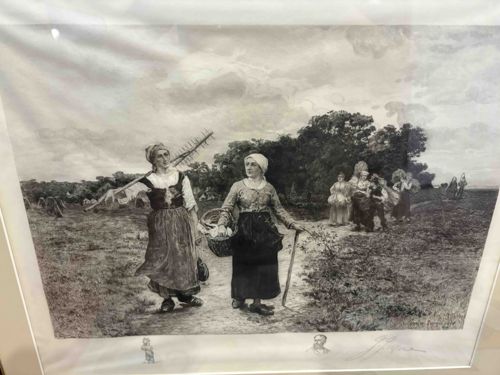
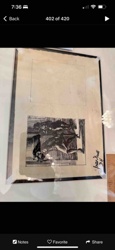
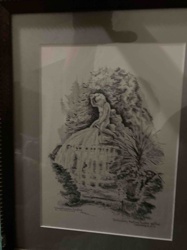
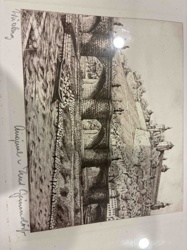
This item is an ink drawing depicting an agricultural scene with several peasant women. The artwork is rendered entirely in monochromatic tones, primarily shades of grey and black, suggesting a charcoal drawing, graphite drawing, or an ink wash technique. The composition features two prominent women in the foreground traversing a dirt path; the woman on the left carries a rake-like farm tool over her shoulder, while the woman on the right holds a walking stick and a basket. Both are dressed in traditional peasant attire, including head coverings, long skirts, and blouses. In the mid-ground, a cluster of other women, also appearing to be farm laborers, are engaged in activities or conversing, with bundles or baskets visible. The background shows a continuation of the agricultural landscape, with trees, fields, and a cloudy sky overhead. The overall style suggests a realist or academic approach to depicting rural life, common in 19th-century European art. Visible details include finely rendered drapery in the women's clothing, expressive facial features, and a sense of depth created by the receding landscape. The drawing appears to be matted and framed under glass, exhibiting some glare that obscures clarity in areas, particularly the upper left. There seems to be an artist's signature or inscription in the lower right corner, though illegible from the provided image, and two small vignettes of figures below the main drawing which might be a printer's mark or part of a larger presentation. The paper appears to have some slight warping or rippling, indicated by the light reflections through the glass. The piece evokes a pastoral or genre scene, likely from the late 19th or early 20th century. The quality of line work and shading indicates skilled craftsmanship.
AI Appraisal Report
Based on my examination of the provided image, this ink drawing depicting an agricultural scene with peasant women appears to be a skillfully executed piece. The monochromatic tones and rendering suggest a charcoal, graphite, or ink wash medium. The finely rendered drapery, expressive features, and sense of depth point to a high level of craftsmanship, consistent with a realist or academic style from the late 19th or early 20th century. The composition, featuring prominent figures in the foreground and a receding agricultural landscape, is well-balanced and evocative of rural genre scenes from that period.
From the image, the condition appears good overall, though the paper exhibits some slight warping or rippling, indicated by reflections through the glass. This is a minor concern, potentially correctable with re-matting and framing. The artwork is matted and framed under glass, which generally offers good protection, but the glare obscures clarity in the upper left. I note an illegible artist's signature or inscription in the lower right, and two small vignettes below the main drawing, which could be printmaker's marks or part of a larger presentation.
In terms of market conditions, drawings of this quality, especially those depicting everyday life from this era, generally see moderate demand. Comparable pieces by lesser-known artists of the period, particularly well-executed illustrative or genre scenes, typically sell in the $800-$1,500 range, sometimes more if the artist can be identified and has an established auction record. Demand for traditional academic drawings remains steady among collectors appreciating representational art. The rarity is difficult to assess without artist identification, but such scenes are not uncommon.
Factors significantly impacting value here include the potential identification of a notable artist, which could substantially increase its worth, and conversely, damage to the paper or fading not visible through the glass could lower it. The quality of line work and shading is a strong positive.
It is crucial to state the limitations of an appraisal based solely on images. Authenticity verification is partial at best; I cannot definitively confirm the medium (e.g., ink wash vs. charcoal vs. graphite) or the artist from an image alone. To fully authenticate this piece, an in-person examination is essential to assess the paper, medium, and signature directly. Provenance documentation, such as exhibition history, sales records, or artist's records, would be invaluable for conclusive authentication and a more precise valuation. Scientific testing for paper age or ink composition could also be considered if significant doubts arose during physical inspection.