AI estimate as of September 29, 2025 · verify with a professional before acting
AI-Generated · Verify before acting
Everything on this page is generated by AI for informational purposes only. AI can make mistakes — the AI may misidentify items or misattribute them (artist, maker, brand, designer, origin, era). This is not an official valuation and should not be used for insurance, sale, tax, estate, legal, or lending purposes — or any decision requiring a certified appraisal. It is not an authoritative claim about any person, brand, or rights holder — do not share or rely on it as a factual statement about a third party. Always consult qualified professionals before making financial decisions.
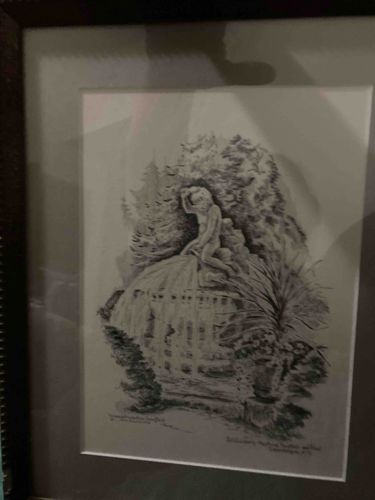
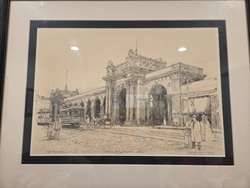
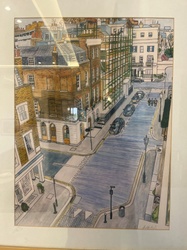
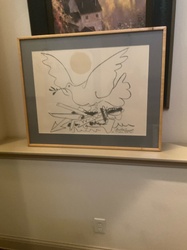
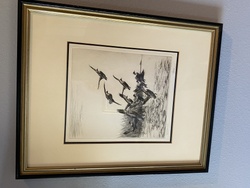
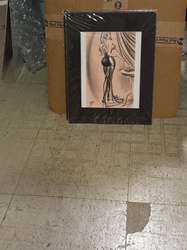
The item is a framed pen and ink drawing or print depicting a classical Roman-style fountain scene. The artwork is characterized by intricate line work and cross-hatching, typical of pen and ink compositions, rendered in black ink on what appears to be white or off-white paper. The central element of the drawing is a seated, draped figure (likely a nymph or classical deity) positioned atop a multi-tiered fountain structure. Water is represented cascading down the tiers of the fountain, with visible architectural details such as balustrades and basin edges. Lush foliage, including trees and dense shrubbery, frames the fountain, creating a rich pictorial depth. In the foreground, to the right, there appears to be a potted plant or structured garden element. The drawing is housed within a dark-colored, possibly wooden, rectangular frame with a matte border. The matte is light-colored, likely off-white or cream, providing a visual separation between the artwork and the frame. The overall condition of the drawing itself is difficult to assess precisely due to the image quality, but there are no immediately obvious tears, significant creases, or large stains visible. The frame appears to be in good condition, with no visible damage. The artistic style suggests a traditional or academic approach, focusing on classical themes and detailed rendering. There are faint lines of text at the bottom, likely an artist's signature, title, or edition number, though illegible from the provided image. The drawing evokes a sense of antique garden architecture and might date from the late 19th to mid-20th century, though without clear markings, this is an estimation based on style.
AI Appraisal Report
Based on my visual examination of the provided image, this framed pen and ink drawing depicts a classical Roman-style fountain scene, rendered with intricate line work and cross-hatching. The composition features a seated, draped figure on a tiered fountain, surrounded by lush foliage, and framed in a dark rectangular frame with a light-colored matte.
From the image, the drawing itself appears to be in good condition, showing no obvious tears, significant creases, or large stains. The frame also seems well-maintained. The artistic style suggests a traditional or academic approach, typical of the late 19th to mid-20th century. While there are faint lines of text at the bottom, likely a signature or title, they are illegible, which limits specifics regarding the artist or origin. Without clearer identification, it's difficult to ascertain if this is an original drawing, a print, or a reproduction. The presence of a signature or edition number, even if illegible, might suggest a print rather than a unique drawing, which would impact its value.
Market conditions for unsigned or unidentified pen and ink works with classical themes are generally moderate. Demand exists for decorative art, but rarity is low unless an established artist is identified. Comparable works by lesser-known or unidentified artists typically fetch values in the lower hundreds, primarily based on their aesthetic appeal and condition as decorative pieces. Factors significantly impacting value include the authenticity as an original drawing versus a print, the artist's identity, and the specific historical period. Without provenance, these factors remain speculative.
Limitations in authenticity verification are significant. Without an in-person examination, I cannot definitively determine if this is an original pen and ink drawing, a lithograph, an etching, or another printmaking technique. A physical inspection would allow for tactile assessment of the paper, close examination of the line work for plate impressions or ink density variations, and a detailed look at the illegible text. Verification of provenance documentation or scientific analysis of the paper and ink would be essential for full authentication and definitive artist attribution, which would substantially increase or decrease its appraisal.