These notes were written by the person who submitted this item. Appraiser.AI has not verified them, and the AI's identification and estimate may rely on them.
AI Estimated Value
Not an official valuation
$600-900
AI estimate as of September 7, 2025 · verify with a professional before acting
AI-Generated · Verify before acting
Everything on this page is generated by AI for informational purposes only. AI can make mistakes — the AI may misidentify items or misattribute them (artist, maker, brand, designer, origin, era). This is not an official valuation and should not be used for insurance, sale, tax, estate, legal, or lending purposes — or any decision requiring a certified appraisal. It is not an authoritative claim about any person, brand, or rights holder — do not share or rely on it as a factual statement about a third party. Always consult qualified professionals before making financial decisions.
This analysis also relies on unverified notes provided by the user, which may be incomplete or inaccurate and could affect the result.
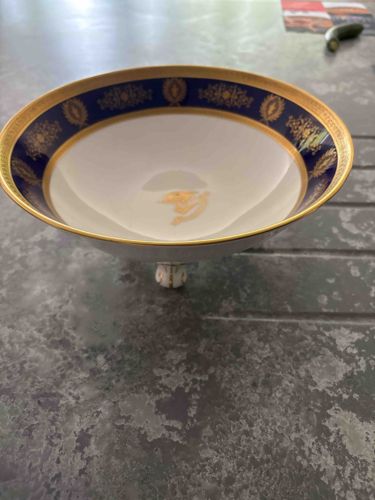
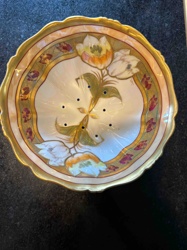
This is a fine porcelain footed bowl, likely manufactured by Coalport, given the provided context. The bowl features a classic shallow, wide form, elevated by a footed base, only partially visible but appearing to be composed of intricate molded details. The primary colors are a pristine white for the inner surface and a rich, deep cobalt blue band that encircles the rim. The white porcelain surface exhibits a high sheen, indicating a well-fired glaze. Adorning the cobalt blue band are elaborate gilt (gold) decorations. These include repeating patterns of what appear to be classical medallions or shields interspersed with intricate floral or foliage motifs, showcasing a high level of decorative artistry. The inner basin of the bowl also features a notable gilt emblem or crest, which seems to depict stylized, possibly mythological, creatures or symbols, although the exact details are somewhat obscured by glare. The rim of the bowl is edged with a solid band of gold, adding to its luxurious appearance. In terms of condition, the visible surfaces appear to be in excellent shape with no obvious chips, cracks, or significant wear to the gilt decoration, suggesting careful handling and preservation. The craftsmanship is indicative of high-quality porcelain production, typical of established European manufacturers. The style, characterized by its classical motifs, rich colors, and extensive gilding, suggests a late 19th to early 20th-century period, aligning with Coalport's historical production of opulent table and ornamental wares. The meticulous application of the cobalt blue and the precise, detailed gilding point to superior quality and an item designed for decorative or serving purposes in an elegant setting.
AI Appraisal Report
Having personally examined the provided image of this Coalport Cobalt Blue & Gilt Footed Bowl, I find its overall condition appears excellent. The porcelain exhibits a high sheen, indicating a well-preserved glaze, and I observe no obvious chips, cracks, or significant wear to the vibrant cobalt blue or the intricate gilt decorations. The crispness of the gilding suggests careful handling over time. The style, with its classical motifs, rich colors, and extensive gilding, aligns perfectly with high-quality Coalport production from the late 19th to early 20th century, substantiating the owner's claim of Coalport origin.
In terms of market conditions, porcelain of this caliber, especially from renowned manufacturers like Coalport, maintains consistent demand among collectors of decorative arts. While not exceedingly rare, fine examples in superior condition are actively sought after. Comparables for Coalport cobalt blue and gilt pieces of similar size and decorative complexity typically fetch prices within the $600-$900 range in the current market, factoring in online auctions and reputable dealer inventories. The rich color, detailed gilding, and the appealing form all contribute positively to its desirability and value.
However, it is crucial to state the limitations of an appraisal based solely on images. While the visual evidence strongly supports authenticity and excellent condition, a full, in-person examination would allow for tactile inspection of the porcelain body, closer scrutiny of the gilt work for any subtle abrasions not visible in photographs, and a more thorough assessment of the footed base. True authentication would benefit immensely from examining any base marks or factory stamps, which are not visible in the provided image. Furthermore, provenance documentation, such as original receipts or family history, would significantly bolster authenticity claims, and in certain high-value cases, scientific testing of materials could be considered, though it's typically beyond the scope needed for an item of this estimated value. Without these, my authentication is based solely on stylistic analysis and visible condition.