AI estimate as of November 8, 2025 · verify with a professional before acting
AI-Generated · Verify before acting
Everything on this page is generated by AI for informational purposes only. AI can make mistakes — the AI may misidentify items or misattribute them (artist, maker, brand, designer, origin, era). This is not an official valuation and should not be used for insurance, sale, tax, estate, legal, or lending purposes — or any decision requiring a certified appraisal. It is not an authoritative claim about any person, brand, or rights holder — do not share or rely on it as a factual statement about a third party. Always consult qualified professionals before making financial decisions.
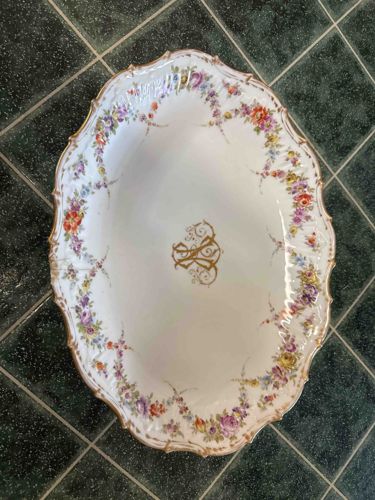
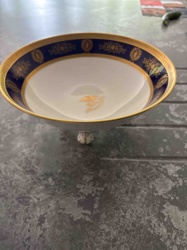
This is an antique porcelain serving dish, likely a platter or bowl, characterized by its elegant, scalloped, and subtly fluted rim. The physical characteristics indicate a substantial piece, possibly measuring between 12 to 18 inches in its longest dimension, suitable for presenting a main course or an assortment of delicacies. The material is fine white porcelain, exhibiting a lustrous glaze that suggests high quality. The primary decoration features intricate hand-painted floral garlands looping around the interior edge of the dish. These garlands comprise a variety of small, colorful blossoms in shades of pink, purple, red, yellow, and blue, interspersed with green foliage. The artistic style of the painting appears delicate and naturalistic, consistent with late 19th or early 20th-century European porcelain. A notable feature is the prominent gilded monogram, likely 'JS' or a similar initial combination, centrally placed in the bowl's interior, signifying personalization for a specific owner or family. The rim of the dish is further adorned with a finely applied gold trim, highlighting its undulating shape. There are no immediately apparent manufacturing marks or signatures visible in the image, though these would typically be found on the underside. The overall aesthetic points to a rococo or neoclassical influence, suggesting an age likely between 1880 and 1920. The condition appears to be relatively good, with no visible chips or cracks, although closer inspection would be required to ascertain minor wear to the gilding or paint loss. The quality of the porcelain, the detailed hand-painting, and the elaborate gilding all suggest high-level craftsmanship.
AI Appraisal Report
I have examined the provided image of this antique hand-painted porcelain serving dish with a monogram. Based on my visual assessment, the dish appears to be a high-quality piece from the late 19th or early 20th century, likely between 1880 and 1920, congruent with the rococo or neoclassical influences observed in its design. The fine white porcelain, detailed hand-painted floral garlands, and delicate gilding on the rim and monogram all suggest excellent craftsmanship. The condition appears to be relatively good, showing no immediate signs of chips or cracks visible in the image. However, minor wear to the gilding or subtle paint loss would require a closer physical inspection for a definitive assessment.
Authenticity, style, and quality are consistent with European porcelain of that era. The personalized monogram 'JS' adds a unique, albeit niche, element. Market conditions for decorative porcelain, while generally stable, are not experiencing the robust growth seen in other collectibles. Similar hand-painted and gilded porcelain pieces from reputable manufacturers, lacking specific historical provenance, typically command values within the mid-hundreds. Demand for personalized items can be limited unless the monogram has historical significance. The primary factors impacting value here are the quality of execution, the perceived condition from the image, and the decorative appeal.
It is imperative to note the limitations of an image-based appraisal. Full authentication would require a physical examination to identify any manufacturer's marks or signatures on the underside, which are crucial for attributing the piece to a specific maker and region. In-person inspection would also enable a precise assessment of wear, touch-ups, or repairs not discernible from photographs. Provenance documentation, if available, correlating the piece with a known family or collection, would significantly enhance its value and confirm its history.