AI estimate as of July 31, 2026 · verify with a professional before acting
AI-Generated · Verify before acting
Everything on this page is generated by AI for informational purposes only. AI can make mistakes — the AI may misidentify items or misattribute them (artist, maker, brand, designer, origin, era). This is not an official valuation and should not be used for insurance, sale, tax, estate, legal, or lending purposes — or any decision requiring a certified appraisal. It is not an authoritative claim about any person, brand, or rights holder — do not share or rely on it as a factual statement about a third party. Always consult qualified professionals before making financial decisions.
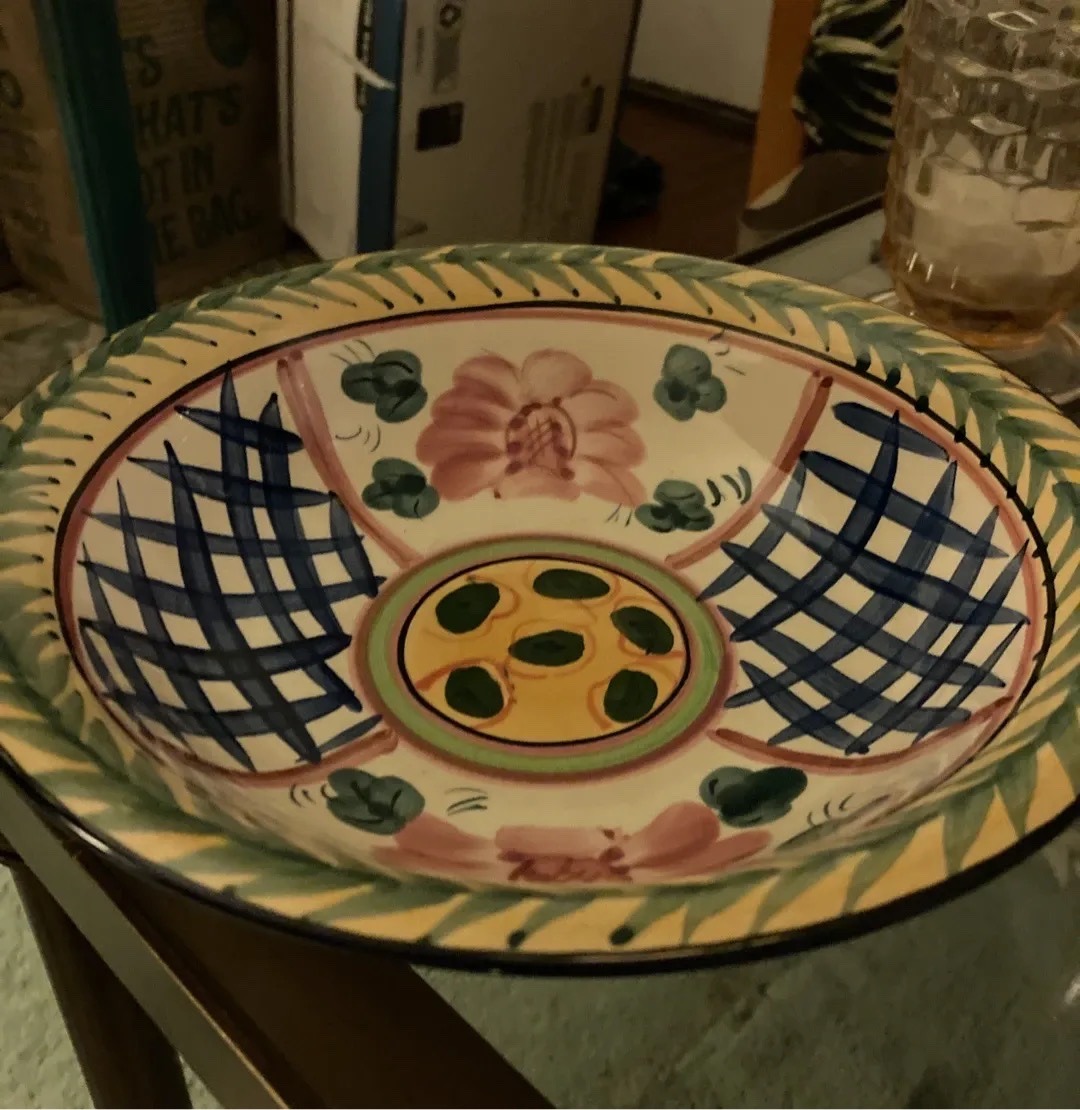
This physical item appears to be a decorative ceramic bowl or deep serving dish featuring a hand-painted, multi-colored polychrome design. The piece is constructed from glazed pottery with a cream-colored base. The interior decoration is sectioned and features repeating motifs, including two large pink floral blossoms with green leaves, alternating with two panels containing a blue cross-hatch or plaid pattern. The very center of the bowl displays a circular medallion with a yellow background and dark green spots, outlined by concentric rings of green and pink. The wide rim is decorated with a continuous band of green and yellow feather-like or leaf-like brushstrokes. The surface shows a glossy glaze with visible crazing and minor irregularities consistent with hand-crafted or traditional earthenware manufacturing techniques. Regarding style and age, the piece is stylistically consistent with 20th-century European majolica or Italian-style ceramics, often associated with Mediterranean earthenware traditions; however, this is a stylistic observation and not a dated fact. There is no maker's mark, signature, or stamp visible in the photograph. Therefore, hedged language has been used in the item name because the absence of a visible hallmark or stamp means the identification relies entirely on visual stylistic features rather than physical proof of origin, maker, or era. The condition appears generally well-preserved with no obvious chips or cracks visible from this angle, though minor surface wear and manufacturing flaws may be present upon closer physical inspection.
AI Appraisal Report
Based on what I can see in the photograph, this decorative ceramic bowl presents visual characteristics stylistically consistent with 20th-century European majolica or Italian-style earthenware. The piece features a hand-painted polychrome design with repeating floral motifs, a plaid pattern, a central medallion, and a feathered rim, all under a glossy, crazed glaze. However, I can't verify from a photo whether the piece is a mid-century Italian import, a later studio ceramic, or a tourist souvenir 'in the style of' traditional majolica. There is no visible maker's mark or signature to review, meaning the identification relies entirely on visual stylistic features rather than physical proof of origin. The condition appears well-preserved with no obvious chips or cracks visible from this angle, though would need physical inspection to confirm the presence of minor wear, hairline fractures, or manufacturing flaws. My value estimate of $150–$300 assumes that the piece is a quality 20th-century European decorative earthenware item. General market demand for mid-century European majolica-style ceramics remains steady among decorative arts collectors, though unbranded and unattributed pieces typically occupy a modest price point. If physical inspection reveals the piece to be a modern reproduction, replica, or a lower-quality decorative copy rather than a period piece, the value would likely decrease to the $50–$100 range. To establish a stronger assessment of attribution, value, and authenticity, one would need physical inspection, hallmark verification, provenance documentation, and potentially consultation with a ceramics specialist.