AI estimate as of August 10, 2025 · verify with a professional before acting
AI-Generated · Verify before acting
Everything on this page is generated by AI for informational purposes only. AI can make mistakes — the AI may misidentify items or misattribute them (artist, maker, brand, designer, origin, era). This is not an official valuation and should not be used for insurance, sale, tax, estate, legal, or lending purposes — or any decision requiring a certified appraisal. It is not an authoritative claim about any person, brand, or rights holder — do not share or rely on it as a factual statement about a third party. Always consult qualified professionals before making financial decisions.
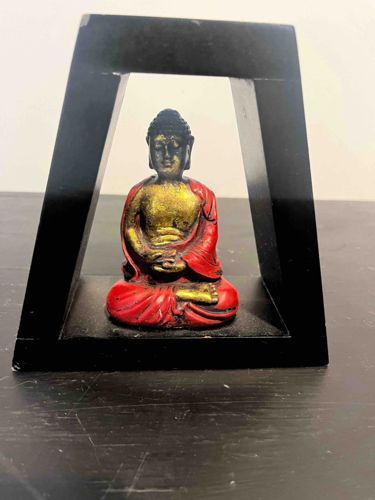
This item is a small, seated Buddha figurine housed within a minimalist black wooden frame. The Buddha figure itself appears to be crafted from a resin or composite material, painted with striking colors. The robe of the Buddha is a vibrant, deep red with visible folds and drapery, suggesting a textured finish. The exposed skin areas, including the chest, arms, and parts of the legs/feet, are painted with a metallic gold finish, which shows some wear or intentional antiquing, revealing darker tones underneath. The face and hair of the Buddha are dark, likely black or dark grey, providing a contrast to the gold and red. The Buddha is depicted in a meditating posture, with hands resting in the lap, fingers interlocked in a common mudra. The frame is a simple, rectangular prism shape, open at the top and front, made of what appears to be black-painted wood or MDF. The interior base of the frame serves as the platform for the Buddha. The frame shows some minor surface wear, including light scratches and scuffs, particularly on the corners and edges, indicating modest handling or age. There are no discernible maker's marks or signatures visible from the provided image. The overall style suggests a modern decorative piece, likely manufactured in the late 20th or early 21st century, designed for home decor or personal spiritual use. The craftsmanship appears to be mass-produced but with a decorative finish.
AI Appraisal Report
I have carefully examined the provided image of the Seated Buddha Figurine in Black Wood Frame. My assessment is based solely on visual inspection, and I must emphasize the limitations inherent in appraising items without a direct physical examination.
Condition and Authenticity: The figurine appears to be in good overall condition for a decorative piece, with the described minor surface wear on the frame consistent with modest handling or age. The wear on the gold finish of the Buddha appears to be either intentional antiquing or minor wear, which is not unusual for such items. Authenticity, in terms of its origin as a mass-produced modern decorative piece, appears consistent with its visual characteristics; it does not present as an antique or a unique artisan creation. There are no signs that would immediately suggest it is not what it purports to be.
Market Conditions and Comparables: Similar mass-produced resin or composite Buddha figurines, housed in simple frames or stands, are widely available in the retail market, often through home decor stores, online marketplaces, or spiritual/gift shops. These items typically fall into the budget-friendly to mid-range decorative category. The craftsmanship, while aesthetically pleasing, does not suggest high-end artistic production.
Demand and Rarity: There is a steady, but not particularly high, demand for decorative spiritual items like this Buddha figurine, driven by general home decor interests. However, the market is saturated with similar products, making this specific item neither rare nor unique. Its mass-produced nature contributes to its commonality.
Factors Impacting Value: The primary factors impacting value for this item are its decorative appeal, its condition, and its nature as a mass-produced item. The lack of rarity, significant age, provenance, or discernible artist/maker reduces its potential for higher value. Its utility is primarily ornamental.
Limitations and Further Verification: Without in-person examination, it's impossible to verify the exact material composition of the figurine or the frame beyond visual estimation. I cannot confirm the quality of the paint application or the exact weight and texture, which can sometimes provide clues to manufacturing process. Detailed provenance documentation, such as purchase receipts or known history of ownership, would be necessary to establish any unique value beyond its decorative merit. Scientific testing would be undue for an item of this likely value and nature but, hypothetically, could verify material composition if there were questions.