These notes were written by the person who submitted this item. Appraiser.AI has not verified them, and the AI's identification and estimate may rely on them.
AI Estimated Value
Not an official valuation
$15-25
AI estimate as of August 2, 2025 · verify with a professional before acting
AI-Generated · Verify before acting
Everything on this page is generated by AI for informational purposes only. AI can make mistakes — the AI may misidentify items or misattribute them (artist, maker, brand, designer, origin, era). This is not an official valuation and should not be used for insurance, sale, tax, estate, legal, or lending purposes — or any decision requiring a certified appraisal. It is not an authoritative claim about any person, brand, or rights holder — do not share or rely on it as a factual statement about a third party. Always consult qualified professionals before making financial decisions.
This analysis also relies on unverified notes provided by the user, which may be incomplete or inaccurate and could affect the result.
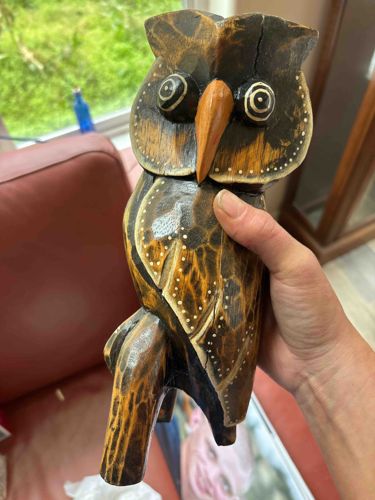
This is a hand-carved wooden owl figurine, exhibiting a folk art or rustic style. The physical characteristics include a substantial size, appearing to be approximately 10-12 inches tall based on the hand holding it for scale. It is carved from a single piece of wood, possibly a lighter timber, which has been stained or painted to achieve a mottled brown and dark brown/black appearance, mimicking natural wood grain and plumage. The prominent features include large, stylized circular eyes painted with concentric white and darker rings, giving a wide-eyed, almost inquisitive expression. There is a distinct, pointed wooden beak, likely carved separately and integrated, or perhaps carefully shaped from the main block. The body is adorned with small, uniformly spaced white dots, possibly applied with paint, suggesting feather patterns. The craftsmanship appears to be relatively raw and unrefined, characteristic of handcrafted items, with visible carving marks and natural wood imperfections contributing to its character. There is a significant vertical crack visible on the top of the owl's head, indicating either drying or impact damage, which affects its overall condition. The finish shows some wear and variations in color, suggesting age and handling, contributing to a desirable patina. The base of the owl is carved to resemble legs or a stand, allowing it to sit upright. There are no discernible maker's marks or signatures visible from the provided images. The style points towards a mid-20th century to contemporary creation, likely mass-produced for the decorative market, but with individual carving variations.
AI Appraisal Report
Upon examination of the provided images, I have assessed this hand-carved wooden owl figurine. It presents a charming folk art or rustic aesthetic, likely created as a decorative piece. The carving displays a raw, unrefined quality, which is characteristic of this style and not necessarily a detriment to its appeal. The mottled staining and painted details, particularly the large stylized eyes and dotted plumage, are typical of such decorative carvings, which are often mass-produced by artisans for the tourist or decorative market. The most significant factor impacting its value is the condition. I note a prominent vertical crack on the top of the head, which is a considerable flaw. While some wear and patina can be desirable, this type of structural damage significantly detracts from its market value. Based on my knowledge of the market for comparable mid-20th century to contemporary folk art carvings, items of this nature are plentiful. Without a known artist or workshop mark, its value is purely decorative. While the images provide a good overview, a full authentication would require physical inspection to identify any maker's mark not visible in photos, assess the stability of the crack, and determine the specific type of wood used. Authentication would be less about proving antiquity and more about identifying a specific, collected artist.