AI estimate as of September 1, 2025 · verify with a professional before acting
AI-Generated · Verify before acting
Everything on this page is generated by AI for informational purposes only. AI can make mistakes — the AI may misidentify items or misattribute them (artist, maker, brand, designer, origin, era). This is not an official valuation and should not be used for insurance, sale, tax, estate, legal, or lending purposes — or any decision requiring a certified appraisal. It is not an authoritative claim about any person, brand, or rights holder — do not share or rely on it as a factual statement about a third party. Always consult qualified professionals before making financial decisions.
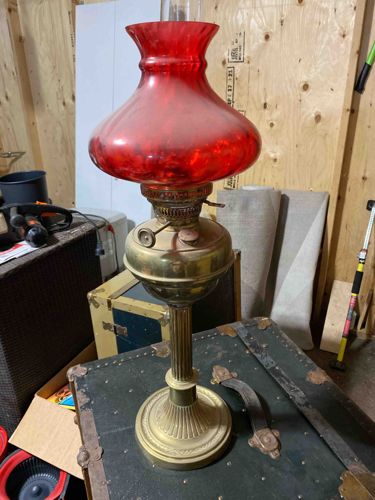
This is an antique or vintage oil lamp, likely a banquet or parlor lamp, constructed primarily of brass with a prominent ruby red glass shade. The overall height appears substantial, suggesting a floor or large table lamp. The base is made of brass and features a wide, circular foot with a fluted design radiating outwards from the central column, indicative of Neoclassical or Victorian influences. An intricate, possibly engine-turned or molded, decorative band adorns the edge of the base. Rising from the base is a reeded or fluted brass column that supports the fount (fuel reservoir). The fount itself is a rounded, classical urn-like shape, also made of brass. Above the fount is the burner mechanism, showing some rust and age, with a wick adjustment knob visible. The most striking feature is the large, bell-shaped ruby red glass shade, which is opaque or translucent rather than transparent, and shows a slight iridescence or mottling, possibly indicative of cranberry glass or cased glass. The shade is dusty, suggesting it has been stored or unused for some time. There is also a clear glass chimney extending from the top of the burner, which is partially visible. The brass components exhibit a distinct patina consistent with age, and some areas of tarnish and dirt are visible. There are no readily apparent cracks or chips in the glass components from the provided image, though a closer inspection would be required. The overall condition suggests a need for cleaning and possibly restoration of the brass finish. The craftsmanship appears solid and typical of late 19th to early 20th-century American or European manufacture.
AI Appraisal Report
Upon visual examination of the provided image, this Brass Oil Lamp with Ruby Red Glass Shade presents as a fine antique, likely late 19th to early 20th century. The design, particularly the fluted base and reeded column, aligns with popular Neoclassical and Victorian Revival styles common in American or European manufacture of that period. The use of solid brass for the fount and base, coupled with the distinctive ruby red glass shade, suggests a quality piece. The shade's possible iridescence or mottling could indicate cranberry or cased glass, which would enhance its value.
The condition appears fair to good for its age, with a clear and consistent patina on the brass. The visible rust on the burner mechanism and general dustiness confirm its age and lack of recent active use or restoration. While no immediate cracks or chips are apparent in the glass components from the images, a thorough in-person inspection would be crucial to confirm this. The brass would benefit significantly from professional cleaning and polishing to restore its luster, which would undoubtedly increase its market appeal. The presence of a clear glass chimney, even if partially obscured, is also a positive sign.
In terms of market conditions, antique oil lamps, especially those with impressive glass shades, maintain a steady demand among collectors of period lighting and decorative arts. The ruby red color is particularly desirable. Comparables for well-preserved, large-scale brass oil lamps with distinctive colored glass shades typically range from $500 to over $1,200, depending on provenance, specific maker (if identifiable), and overall condition. The lack of maker's marks is common for these items, but if present, would elevate the value. Rarity is moderate; while many oil lamps exist, those in this stylistic vein with such a prominent and intact colored shade are less common.
Limitations: It is impossible to definitively determine the precise age, origin, and material composition of the glass (e.g., true cranberry glass vs. flashed glass) solely from images. Furthermore, internal condition of the fount, integrity of the burner mechanism's internal components, and any hidden repairs or damage cannot be assessed. Full authenticity verification, including confirmation of the shade's type, would require in-person examination, potentially UV light inspection for repairs, and if possible, provenance documentation or specific glass analysis for material verification.