AI estimate as of October 8, 2025 · verify with a professional before acting
AI-Generated · Verify before acting
Everything on this page is generated by AI for informational purposes only. AI can make mistakes — the AI may misidentify items or misattribute them (artist, maker, brand, designer, origin, era). This is not an official valuation and should not be used for insurance, sale, tax, estate, legal, or lending purposes — or any decision requiring a certified appraisal. It is not an authoritative claim about any person, brand, or rights holder — do not share or rely on it as a factual statement about a third party. Always consult qualified professionals before making financial decisions.
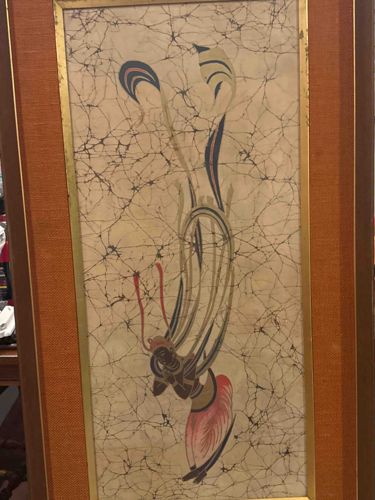
This item is a framed piece of batik art depicting an abstract, elongated figure or creature against a crackled, light-colored background. The artwork is housed within a wooden frame with a gold-tone inner fillet and an outer section covered in an orange, coarse-textured fabric or linen. The visible dimensions suggest a vertical, rectangular format, likely approximately 2 feet tall or more. The central figure is highly stylized, characterized by flowing lines and organic shapes. Predominant colors in the figure include dark navy or black, muted light blue/gray, a warm terracotta or reddish-brown, and a soft pink for a more substantial lower body element. Reddish-orange thin lines extend from the upper part of the figure, adding a dynamic quality. The background exhibits the distinctive web-like crackle pattern inherent to the batik process, which is created by wax resist and dye. This crackling, with its dark lines against a lighter base, provides significant texture and visual interest to the overall composition. The condition of the artwork appears good, with no obvious tears, significant discoloration, or damage visible in the primary art itself. The frame shows minor signs of wear consistent with age, particularly on the gold fillet where some tarnishing or dullness might be present, and the fabric outer frame appears generally clean but might have slight handling marks. The abstract nature of the design, combined with the traditional batik technique, suggests a possible mid-20th century to contemporary origin, perhaps influenced by Asian or ethnic art forms. The craftsmanship appears to be of good quality, typical of decorative art suitable for home or office display. The subject matter is intriguing and open to interpretation, potentially representing a mythical creature, a dancer, or an abstract natural form.
AI Appraisal Report
I have examined the provided image of the Framed Batik Art with Abstract Figure. The artwork's condition appears good, with the batik itself showing no visible tears, significant discoloration, or damage. The crackled background, characteristic of the batik process, is well-executed, adding texture and visual interest. The wooden frame with a gold-tone inner fillet and an orange, coarse-textured fabric outer section presents minor wear consistent with age, such as potential tarnishing on the fillet and slight handling marks on the fabric, but overall is in acceptable condition. Authenticity, based solely on visual examination of the image, suggests it is indeed a genuine batik piece, given the distinctive wax-resist crackle effect. However, without physical inspection, I cannot verify the specific dyes used or the quality of the fabric base.
Market conditions for decorative batik art are generally moderate. While original batik art holds more value than prints, it is not typically considered a high-value collectible unless created by a renowned artist or possessing significant historical provenance. Comparables typically fall into the $100-$300 range for unsigned, decorative abstract batik art of this size and quality. Demand for abstract batik featuring intriguing, stylized figures is consistent, particularly for home or office decor. Rarity is not a significant factor here; while each batik is unique due to the manual process, the style is not exceptionally uncommon.
Factors impacting value include the good overall condition and the appealing abstract design. The lack of a visible signature limits value, as attribution to a known artist would significantly increase it. Without a signature or provenance, it's considered decorative art. For full authentication and to ascertain a more precise value, an in-person examination would be crucial to assess the fabric quality, types of dyes used, and to look for any hidden signatures or artist marks. Provenance documentation, detailing its history and artist, would also be invaluable, though often absent for such decorative pieces.