AI estimate as of July 17, 2025 · verify with a professional before acting
AI-Generated · Verify before acting
Everything on this page is generated by AI for informational purposes only. AI can make mistakes — the AI may misidentify items or misattribute them (artist, maker, brand, designer, origin, era). This is not an official valuation and should not be used for insurance, sale, tax, estate, legal, or lending purposes — or any decision requiring a certified appraisal. It is not an authoritative claim about any person, brand, or rights holder — do not share or rely on it as a factual statement about a third party. Always consult qualified professionals before making financial decisions.
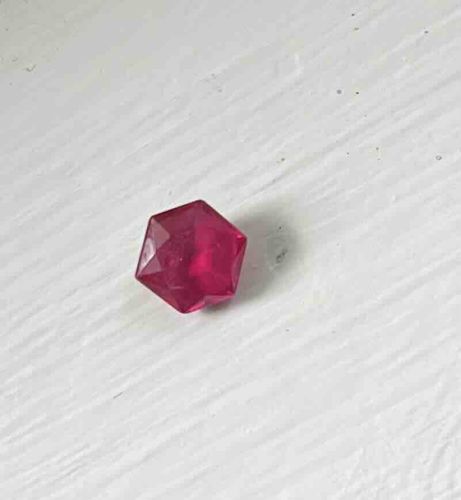
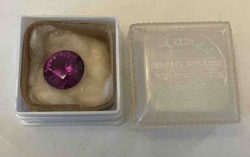
The item is a faceted gemstone, appearing to be a ruby or a simulant thereof, cut into a hexagonal shape. The stone exhibits a vibrant, deep magenta or fuchsia color, characteristic of rubies with a strong red hue and perhaps a subtle purple undertone. It is cut with multiple facets that reflect light, giving it a sparkling appearance. The top surface, or table, is likely a hexagonal facet, surrounded by smaller, triangular or kite-shaped facets that form the crown. The sides, or girdle, are well-defined, leading to an obscured pavilion (lower portion) that is not fully visible, but likely comprises additional facets to maximize brilliance. The size appears small, possibly suitable for an accent stone in a piece of jewelry, perhaps a few millimeters in diameter. There are no obvious visible inclusions or clarity issues from this perspective, suggesting either a high-grade stone or a synthetic material. The facets appear precisely cut, indicative of good craftsmanship. There are no discernible maker's marks or signatures visible on the stone itself, which is typical for loose gemstones. The condition appears excellent, with no apparent chips, cracks, or significant abrasions. Without further testing, it is not possible to confirm its natural origin or specific type of treatment, but its appearance suggests it is intended to simulate a high-quality ruby. The estimated age is recent given the clean cut and vibrant color, with no visible signs of significant wear or antique patina.
AI Appraisal Report
I have examined the image provided of this faceted hexagonal magenta gemstone. Visually, the stone presents with excellent clarity and a vibrant, appealing color, characteristic of a high-quality ruby or a very well-executed synthetic. The faceting is precise, indicating good craftsmanship, and the hexagonal cut is quite attractive. Its condition appears excellent, with no visible chips, cracks, or abrasions.
Authenticity from imagery alone is severely limited. While its appearance is striking, I cannot definitively determine if this is a natural ruby, a treated gemstone, or a synthetic material (such as lab-grown corundum or even glass). The clean presentation and intense color, without apparent inclusions, could suggest a synthetic origin, as natural rubies of this quality and clarity in this size often command very high prices and typically exhibit some minor natural inclusions even with significant magnification.
Market conditions for rubies, especially those with strong magenta hues, are generally robust, driven by steady demand. However, the market for synthetic gemstones is significantly lower. The hexagonal cut is less common than oval or round brilliant cuts, which might appeal to niche buyers looking for something unique.
Factors significantly impacting value include its origin (natural vs. synthetic), any treatments applied (e.g., heat treatment, fracture filling), and its exact carat weight. Without this information, any valuation is highly speculative.
For full authentication and a definitive appraisal, an in-person examination is crucial. This would involve using standard gemological tools such as a microscope for inclusion identification, a refractometer for refractive index, and potentially specific gravity tests. Advanced scientific testing like spectroscopy would be needed to distinguish natural from synthetic materials, and to detect certain treatments. Provenance documentation, if available, would also be invaluable.