AI estimate as of September 2, 2025 · verify with a professional before acting
AI-Generated · Verify before acting
Everything on this page is generated by AI for informational purposes only. AI can make mistakes — the AI may misidentify items or misattribute them (artist, maker, brand, designer, origin, era). This is not an official valuation and should not be used for insurance, sale, tax, estate, legal, or lending purposes — or any decision requiring a certified appraisal. It is not an authoritative claim about any person, brand, or rights holder — do not share or rely on it as a factual statement about a third party. Always consult qualified professionals before making financial decisions.
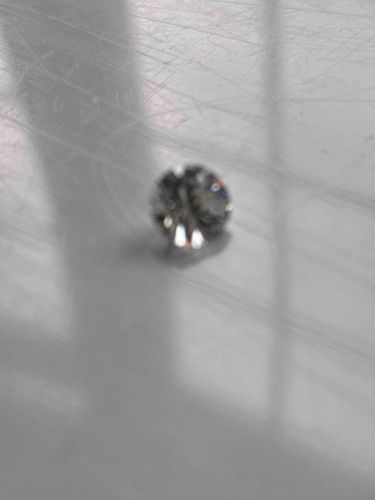
The item appears to be a solitary, faceted gemstone, most likely a diamond or a diamond simulant, exhibiting a brilliant or round brilliant cut. Its small size is evident, and the top facet (table) reflects light, creating bright flashes. The gem displays multiple facets around its girdle, designed to maximize light reflection and sparkle, which is indicative of a well-cut stone. The color appears to be in the colorless to near-colorless range, as suggested by the bright reflections, although a precise color grade cannot be determined from the image. No visible inclusions or blemishes are discernible, but the resolution and lighting make a definitive assessment impossible. The stone is resting on a light-colored, possibly white or very light gray, scratched surface, which provides a neutral background for display. The scratches on the surface suggest wear, but they are external to the gemstone itself. The brilliance and fire of the gem, though somewhat blurred, suggest it is of reasonable quality if indeed a natural diamond. There are no visible settings, mountings, or any manufacturer's marks, indicating this is a loose stone. The overall impression is one of a single, unmounted precious or semi-precious stone, likely intended for use in jewelry.
AI Appraisal Report
Based on my visual examination of the provided image, I assess this loose, faceted gemstone. It appears to be a brilliant or round brilliant cut, exhibiting good light reflection indicative of a well-cut stone. The color seems to fall within the colorless to near-colorless range, likely D-J, though precise grading is impossible without physical inspection. I observe no obvious inclusions or blemishes from the image, suggesting a clarity grade of at least SI1, potentially higher. The brilliance and fire, even through the image's resolution, suggest reasonable quality.
Market conditions for loose diamonds are generally stable, with demand varying based on size, quality, and origin. Given its small size, it's likely intended for accent stones or smaller jewelry pieces. Rarity is difficult to ascertain purely from an image; a natural diamond of good quality holds more value than a simulant.
Factors significantly impacting value include the actual 4Cs (Carat, Cut, Color, Clarity), which are only estimated here. Without accurate weight, and with only subjective visual assessment of cut, color, and clarity, a precise valuation is impossible.
It is crucial to note the severe limitations of authenticity verification from images alone. I cannot definitively confirm if this is a natural diamond, a lab-grown diamond, or a simulant (e.g., cubic zirconia, moissanite). For full authentication and accurate grading, an in-person examination by a certified gemologist is essential. This would involve specific gravity tests, refractometer readings, thermal conductivity tests, microscopy for inclusion identification, and fluorescence examination. Provenance documentation (e.g., GIA, AGS certificate) would also be required to trace its origin and confirm treatments. My appraisal value range reflects the uncertainty due to these limitations.