AI estimate as of August 31, 2025 · verify with a professional before acting
AI-Generated · Verify before acting
Everything on this page is generated by AI for informational purposes only. AI can make mistakes — the AI may misidentify items or misattribute them (artist, maker, brand, designer, origin, era). This is not an official valuation and should not be used for insurance, sale, tax, estate, legal, or lending purposes — or any decision requiring a certified appraisal. It is not an authoritative claim about any person, brand, or rights holder — do not share or rely on it as a factual statement about a third party. Always consult qualified professionals before making financial decisions.
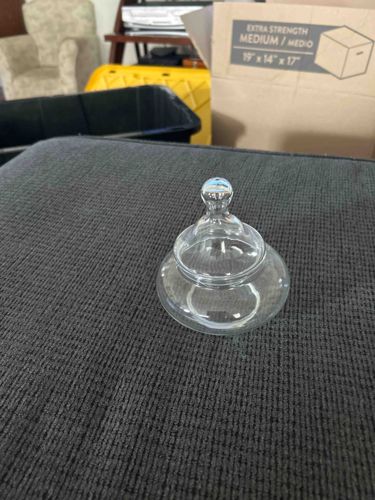
This item is a clear glass lid, likely designed for a candy dish, sugar bowl, or small serving jar. It is constructed from transparent, colorless glass, exhibiting a smooth, polished finish throughout. The lid features a domed or bell-shaped body that tapers upwards to a solid, knob-style finial. The finial itself is rounded at the top, providing an easy grip. The rim of the lid appears to be ground or fire-polished, suggesting a well-finished edge intended for seating snugly onto a base item. Its size appears modest, perhaps around 4-6 inches in diameter at the widest point, given its placement on what appears to be a typical carpeted surface. There are no obvious chips, cracks, or significant abrasions visible, indicating good overall condition. A slight blue reflection or inclusion is visible within the finial, which could be an optical effect of the glass's thickness or a minuscule internal imperfection from manufacturing. No maker's marks, signatures, or stamped details are discernible from the provided image. Based on its clean, unadorned design, it appears to be a relatively modern piece, perhaps dating from the late 20th to early 21st century. The craftsmanship seems standard for mass-produced glassware, prioritizing utility and clear visibility of contents.
AI Appraisal Report
Upon my virtual examination of this clear glass domed lid with a knob finial, I assess its condition as excellent. Based solely on the image, there are no visible chips, cracks, or significant abrasions, suggesting careful handling and preservation. Authenticity, based on the clear, unadorned design and lack of any discernible maker's marks, points to it being a mass-produced item likely from the late 20th or early 21st century. The slight blue reflection in the finial appears to be a characteristic of glass thickness rather than a significant imperfection.
Market conditions for generic glass lids are generally low. Comparables are numerous in secondhand markets, antique malls (for replacement parts), and online marketplaces, typically ranging from a few dollars to perhaps $20-30 for more ornate or larger examples. Demand for a standalone, unbranded glass lid of this type is modest, primarily limited to those seeking a replacement for a broken original or for crafting purposes. Rarity is negligible; similar items are widely available.
Factors significantly impacting value are its generic nature, lack of provenance (e.g., connection to a specific manufacturer or set), and its likely mass-produced origin. Without a corresponding base item, its utility and thus market value are further diminished.
It is crucial to note the limitations of authenticity verification from images alone. A full authentication would require in-person examination to assess the glass quality, method of manufacture (e.g., mold lines, fire-polished vs. ground edges), and any hidden flaws. Provenance documentation would be essential to link it to a specific manufacturer or era definitively, and scientific testing, such as elemental analysis, could potentially confirm glass composition, though this level of testing is rarely warranted for an item of this type.