AI estimate as of October 30, 2025 · verify with a professional before acting
AI-Generated · Verify before acting
Everything on this page is generated by AI for informational purposes only. AI can make mistakes — the AI may misidentify items or misattribute them (artist, maker, brand, designer, origin, era). This is not an official valuation and should not be used for insurance, sale, tax, estate, legal, or lending purposes — or any decision requiring a certified appraisal. It is not an authoritative claim about any person, brand, or rights holder — do not share or rely on it as a factual statement about a third party. Always consult qualified professionals before making financial decisions.
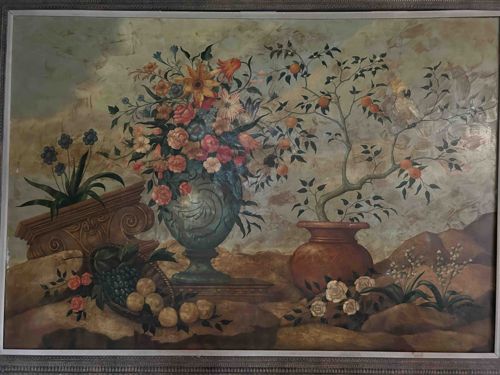
This item is an oil (or acrylic) painting depicting a classical still life composition. It features a central arrangement of lush, colorful flowers in shades of pink, orange, yellow, and blue, contained within an ornate, greenish-blue classical urn or vase that appears to be made of painted metal or ceramic, resting on a rocky or architectural plinth. To the left of the central vase, a broken or fallen classical architectural element, potentially an Ionic capital fragment with scrollwork, is visible, topped with a small blue flowering plant. Below this, a woven basket overflows with dark grapes and light-colored fruits, possibly peaches or apples. To the right of the central elements, a small, gnarled tree with green leaves and orange fruits, resembling oranges or mandarins, sprouts from a reddish-brown earthenware pot. Additional small white roses or similar flowers and green foliage are scattered in the foreground. The background features a mottled sky-like effect on the left and a more earth-toned, rocky landscape on the right, suggesting an outdoor or fresco setting. The overall color palette leans towards earthy tones with vibrant floral and fruit accents. The painting is framed in a simple, likely wooden, silver-painted or distressed frame with a slightly textured or aged finish. The visible condition suggests some age, with a slight darkening or yellowing of the varnish, and potential minor wear around the edges consistent with being framed. There are no immediate visible signs of major damage like tears or punctures, but the surface appears a bit uneven or textured, which could be intentional or a result of age/material. The style suggests an influence of classical European still life painting, perhaps from the 18th or 19th century, or a later reproduction or decorative piece mimicking that style. The craftsmanship appears to be of a decent decorative quality, with attention to detail in the flora and fauna, though the brushstrokes are somewhat broad in areas, indicating a more illustrative than hyper-realistic approach.
AI Appraisal Report
Based on my visual examination of the provided image of the 'Still Life with Classical Elements and Fruit Tree Painting,' I assess its condition as good decorative quality, consistent with its likely age. There is a perceptible darkening or yellowing of the varnish, which is common in older oil paintings and contributes to its aged aesthetic. I observe no immediate signs of major damage like tears or punctures, though the surface texture appears uneven in places, which could be intentional or due to age. The simple, distressed silver-painted frame complements the piece.
From a market perspective, this piece falls into the decorative art category, offering an aesthetic nod to classical European still life. Comparables in this vein often come from the 19th or early 20th century, or later reproductions, and generally perform moderately in the market. Demand for such pieces is steady among collectors seeking classical decor, but it is not considered rare. Factors impacting value include the visible brushwork, which is more illustrative than hyper-realistic, suggesting it's not by a highly acclaimed master, but rather a skilled artisan. The quality of the composition and vibrant color palette are positive attributes.
It is crucial to note the limitations of image-based appraisal. Without in-person examination, I cannot definitively verify the medium (oil or acrylic), the exact age, or the presence of any underlying repairs. Full authentication would require a physical inspection to assess brushstroke intricacies, pigment analysis, and a blacklight examination for possible restorations. Provenance documentation would also be vital to establish its history and artist attribution, if any. Given these limitations, the current valuation reflects its qualities as an attractive decorative work.