AI estimate as of December 4, 2025 · verify with a professional before acting
AI-Generated · Verify before acting
Everything on this page is generated by AI for informational purposes only. AI can make mistakes — the AI may misidentify items or misattribute them (artist, maker, brand, designer, origin, era). This is not an official valuation and should not be used for insurance, sale, tax, estate, legal, or lending purposes — or any decision requiring a certified appraisal. It is not an authoritative claim about any person, brand, or rights holder — do not share or rely on it as a factual statement about a third party. Always consult qualified professionals before making financial decisions.
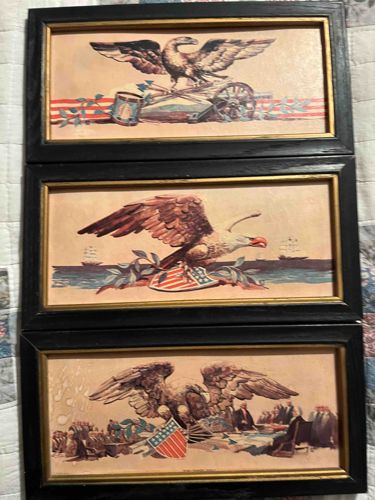
This is a set of three vertical rectangular framed prints, each depicting an American bald eagle in a patriotic scene. Each print is housed in a simple, flat-profile black wooden frame with a narrow, subtly gilded inner border that separates the black frame from the artwork. The frames appear to be made of painted wood, showing some light wear and possible dust accumulation consistent with age and handling. The prints themselves feature a muted, somewhat sepia-toned background characteristic of older prints, with the eagles and associated elements rendered in vibrant but harmonized colors. The top print shows an eagle perched atop a cannon and a drum, with an American flag draped around the artillery. The middle print displays an eagle perched on a laurel wreath containing an American shield, with naval ships visible in the background against a blue sky or sea. The bottom print features a larger eagle with an American flag shield, overlooking what appears to be a historical tableau, possibly a depiction of a constitutional convention or a similar foundational American event with figures in period attire. There are no visible artist signatures or specific manufacturing marks discernible from the image. The prints appear to be either lithographs or chromolithographs, dating perhaps to the mid-20th century, possibly as early as the 1940s-1960s, given the style and framing. The condition of the prints themselves shows some visible wear, including what might be slight discoloration, minor creasing, or age-related foxing, particularly noticeable as lighter spots or areas of inconsistency on the paper surfaces. The glass covering the prints, if present, is clear, and there are no significant glares or reflections obscuring the artwork. The craftsmanship of the prints suggests mass production for decorative purposes, typical of patriotic decor from their estimated period. The overall quality is fair, with the frames adding a classic, understated presentation.
AI Appraisal Report
I have examined the provided image of this Set of Three Framed Patriotic American Eagle Prints. The prints appear to be mass-produced decorative items, likely chromolithographs dating from the mid-20th century, possibly the 1940s-1960s, given their style and framing. The frames are simple black wood with a gilded inner border, showing light wear. The prints themselves exhibit signs of age, including potential discoloration, minor creasing, or foxing, which impacts their overall condition. The themes are distinctly patriotic, featuring bald eagles with American flags and historical elements, which typically appeals to a niche market. Demand for such vintage decorative patriotic prints is moderate, driven by collectors of Americana or those seeking period-appropriate decor. These are not rare items; similar sets or individual prints often appear in antique malls and online marketplaces. The lack of artist signatures or specific manufacturing marks, combined with the apparent mass-produced quality, prevents a higher valuation. Factors significantly impacting value are the age-related condition issues of the prints and their decorative, rather than fine art, status. Without a physical inspection, I cannot confirm the exact printing technique (e.g., lithograph vs. chromolithograph) or definitively assess the extent of discoloration, foxing, or paper integrity. Identifying specific printmakers, if any, and determining the exact date would require an in-person examination, including potential removal from frames, to check for hidden marks or paper characteristics. Provenance documentation could also shed light on their origin. However, based solely on the image, these appear to be good quality decorative pieces from their era.