These notes were written by the person who submitted this item. Appraiser.AI has not verified them, and the AI's identification and estimate may rely on them.
AI Estimated Value
Not an official valuation
$10-25
AI estimate as of September 20, 2025 · verify with a professional before acting
AI-Generated · Verify before acting
Everything on this page is generated by AI for informational purposes only. AI can make mistakes — the AI may misidentify items or misattribute them (artist, maker, brand, designer, origin, era). This is not an official valuation and should not be used for insurance, sale, tax, estate, legal, or lending purposes — or any decision requiring a certified appraisal. It is not an authoritative claim about any person, brand, or rights holder — do not share or rely on it as a factual statement about a third party. Always consult qualified professionals before making financial decisions.
This analysis also relies on unverified notes provided by the user, which may be incomplete or inaccurate and could affect the result.
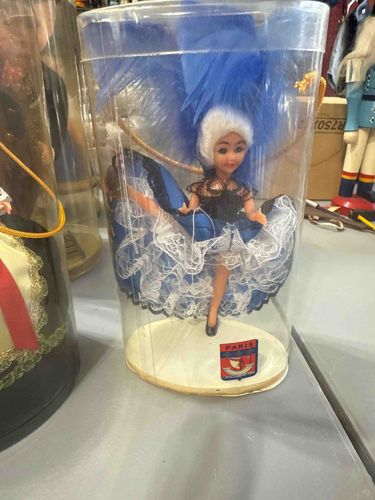
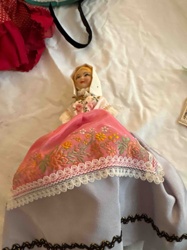
This item is a souvenir doll, likely from France, depicting a Can-Can dancer, presented in a clear plastic cylindrical display case. The doll itself is relatively small, with a light-skinned complexion, dark eyes, and short, wavy white hair. She is dressed in a theatrical costume consistent with a Can-Can dancer, featuring a black or dark-colored bodice with intricate gold-toned or brown detailing, and a voluminous skirt. The skirt is primarily a vibrant royal blue, adorned with layers of white lace and ruffles, indicating movement and flair. Notable features include the doll's pose, with one leg raised high as if in mid-dance, and her arms slightly bent, adding to the dynamic presentation. A large, fluffy adornment of bright blue feathers is positioned behind her head, simulating the elaborate headwear or feather boas often associated with Can-Can performers. The doll stands on a circular, off-white base within the clear cylindrical case. Attached to this base is a distinctive sticker that reads 'PARIS' with what appears to be a crest or emblem, confirming its origin as a souvenir from the French capital. The plastic display case itself shows some signs of age or handling, possibly some scuffs or light scratches, but appears largely intact, protecting the doll from dust and damage. The overall condition of the doll appears good, with no visible rips or tears in the fabric, and the 'German doll' context is a misdirection, as the 'PARIS' sticker clearly indicates otherwise. This item is characteristic of tourist memorabilia produced from the mid-to-late 20th century.
AI Appraisal Report
Upon examination of the provided images, I have assessed this Can-Can Dancer Souvenir Doll. The item appears to be in good, well-preserved condition, protected by its original clear plastic display case. The costume is vibrant, and the doll is free from visible damage such as tears or significant fading. The sticker on the base clearly reads 'PARIS,' which contradicts the owner's suggestion of it being a 'German doll' and firmly places it as a piece of French tourist memorabilia. These types of dolls were mass-produced, primarily from the mid-to-late 20th century, and are common in the secondary market.
The value of such souvenir items is primarily sentimental rather than monetary. The market for mass-produced tourist dolls is not strong, and they are not considered rare. Comparables on online marketplaces and auction sites typically sell for modest amounts. The primary factor influencing value here is its nature as a common souvenir. While the condition is good, its mass-produced origins and the high supply available limit its value significantly.
It is important to note that this appraisal is based solely on images. A full authentication would require in-person examination to confirm the materials used (e.g., plastic type, fabric composition) and to inspect for any manufacturer's marks hidden on the doll's body or under its clothing. However, given the item's clear characteristics as a souvenir, extensive scientific testing or documentation is not expected to materially alter its value.