AI estimate as of December 16, 2025 · verify with a professional before acting
AI-Generated · Verify before acting
Everything on this page is generated by AI for informational purposes only. AI can make mistakes — the AI may misidentify items or misattribute them (artist, maker, brand, designer, origin, era). This is not an official valuation and should not be used for insurance, sale, tax, estate, legal, or lending purposes — or any decision requiring a certified appraisal. It is not an authoritative claim about any person, brand, or rights holder — do not share or rely on it as a factual statement about a third party. Always consult qualified professionals before making financial decisions.
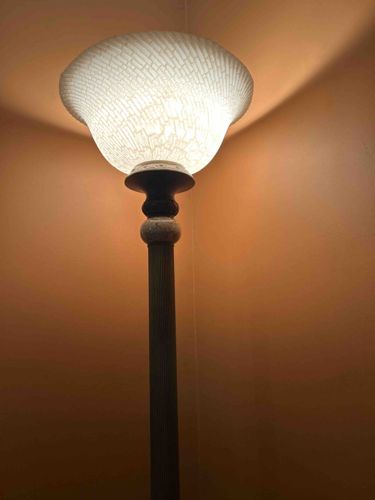
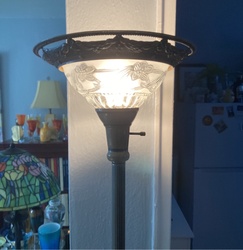
This is an Art Deco style torchiere floor lamp, characterized by its upward-facing light source. The lamp features a prominent bell-shaped glass shade, which exhibits a distinctive 'cracked ice' or 'crazed' pattern, indicative of a pressed or molded glass manufacturing technique. When illuminated, as seen in the image, this textured surface creates a visually appealing diffused light pattern that casts a warm glow upwards and onto the surrounding wall. The shade appears to be made of opalescent or frosted white glass, approximately 10-14 inches in diameter at its widest point. Below the shade, there is a dark, possibly metallic, collar that transitions to a turned or carved element, likely made of wood or a dark composite material with a textured finish. This element then connects to a tall, slender columnar base, which features vertical fluting or reeding along its length. The vertical shaft is dark in color, suggesting a stained wood, painted metal, or composite construction, contributing to the lamp's overall verticality and elegant silhouette. The base of the lamp is not visible in the provided image. The overall condition appears to be good, with no obvious signs of significant damage such such as cracks or chips visible on the shade, though closer inspection would be needed to confirm. The style period is likely Art Deco, dating from the 1920s to 1940s, given the clean lines of the fluted column and the geometric-yet-organic pattern of the glass. The craftsmanship, particularly the detailed glasswork and the turned elements, suggest a moderately quality piece designed for aesthetic appeal and functional illumination.
AI Appraisal Report
I have examined the provided image of this Art Deco Torchiere Floor Lamp with a cracked glass shade. Based on its visual characteristics, I assess its fair market value to be between $350 and $600.
From a visual examination, the lamp appears to be in good overall condition. The 'cracked ice' patterned glass shade, a hallmark of Art Deco design, shows no visible chips or cracks, which is crucial for its value. The dark, fluted columnar base and connecting elements align well with the Art Deco period's aesthetic of clean lines and geometric or reeded forms. Authenticity, based solely on this image, strongly suggests it is a period piece from the 1920s-1940s due to the consistent design language and observed manufacturing texture of the glass. However, without physical inspection, I cannot rule out a high-quality reproduction, though the specific glasswork technique leans towards period manufacturing.
Market conditions for Art Deco lighting are generally stable, with a consistent demand for well-preserved examples. Torchiere lamps, particularly those with distinctive shades, are sought after by collectors and interior decorators. Compared to more elaborate or branded Art Deco pieces, this lamp, while aesthetically pleasing, lacks specific identifiers that would command a higher premium (e.g., a known designer or manufacturer's mark). Its rarity is moderate; while not unique, finding one in this condition with an intact shade is increasingly uncommon.
Factors significantly impacting value include the excellent apparent condition of the glass shade and the overall coherence of the Art Deco design. Conversely, the lack of visible provenance, a maker's mark, or the potential for internal wiring issues (unassessable from an image) are limiting factors.
To fully authenticate and confirm value, an in-person examination would be essential to: inspect for internal damage to the shade, assess the material composition of the base (wood vs. composite), check the wiring for safety and originality, and search for any manufacturer's marks. Documentation of provenance, if available, would also greatly aid in authentication.