AI Appraisal Estimate

AI-generated estimates · not official valuations

From the user

What was submitted

Photo and notes provided by the user — not generated by AI

Submitted item photo
Submitted photo · June 17, 2026

User's notes

No additional notes provided.

AI analysis below

AI appraisal

AI analysis & estimate

AI-Generated · Verify before acting

Everything below is generated by AI for informational purposes only. AI can make mistakes — the AI may misidentify items or misattribute them (artist, maker, brand, designer, origin, era). This is not an official valuation and should not be used for insurance, sale, tax, estate, legal, or lending purposes — or any decision requiring a certified appraisal. It is not an authoritative claim about any person, brand, or rights holder — do not share or rely on it as a factual statement about a third party. Always consult qualified professionals before making financial decisions.

Read the full disclaimer

AI Identification

·Not independently authenticated·Verify before acting

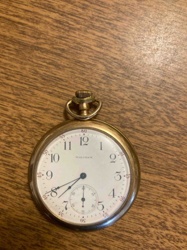
Antique Waltham Gold-Filled Pocket Watch

Antique Timepieces / Horology

AI Estimated Value

·Not an official valuation·Verify before acting

$150 - $250

As of June 17, 2026

AI Item Analysis

·AI can make mistakes·Verify before acting
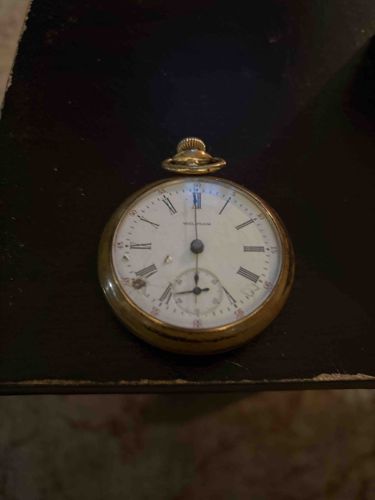
This is an antique open-face pocket watch manufactured by the American Waltham Watch Company, likely dating from the late 19th to early 20th century (approx. 1890-1915). The watch features a classic circular case with a gold-toned finish, most likely gold-filled or plated over a base metal. The white enamel dial, often referred to as a 'double sunk' or single-layer porcelain dial, displays elongated black Roman numeral hour markers and a secondary sunken seconds sub-dial at the 6 o'clock position. The outer perimeter includes a minute track with small Arabic numerals in red, an aesthetic common in rail-road era styling. The hands appear to be blued steel, including a spade-weighted hour hand and a slim minute hand. The crown and bow are located at the 12 o'clock position, indicating a stem-set and stem-wound movement. Regarding condition, there is significant visible damage to the porcelain dial between the 7 and 8 o'clock markers, showing localized cracking (crazing) and a loss of enamel with visible substrate underneath. The crystal shows faint surface scratches, and the gold case exhibits minor wear and patina consistent with age and regular handling. The Waltham branding is visible below the 12 o'clock marker. This piece represents a high standard of American industrial horology and craftsmanship from the golden age of mechanical watchmaking.
AI Appraisal Report

·AI can make mistakes·Verify before acting
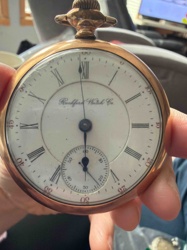
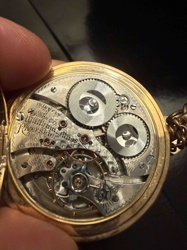
I have examined the digital representation of this American Waltham Watch Company open-face pocket watch, dating to the late 19th or early 20th century. My visual assessment confirms the watch possesses period-correct characteristics, including the blued steel spade hands and the double-sunk porcelain dial. However, the condition of the dial is a significant detracting factor. There is a substantial chip and 'spider' cracking radiating between the 7 and 8 o’clock markers, which severely impacts the aesthetic and collector value. While the gold-filled case shows expected honest wear, the dial damage is irreversible. From a market perspective, Waltham was a prolific manufacturer; consequently, standard gold-filled models are readily available. The current market for American pocket watches is driven by railroad-grade movements and pristine enamel dials. This specimen, likely a 15-to-17 jewel model, serves as a fine entry-level piece but lacks the rarity or condition to command a premium. I have valued this based on recent auction results for damaged Waltham watches of similar caliber. It is important to note that this appraisal is based solely on images. Without an in-person physical inspection, I cannot verify the movement's serial number for exact dating, the functioning state of the balance wheel, or the thickness of the gold-fill layer. A full authentication would require opening the case back to inspect the movement for rust, mechanical integrity, and to confirm the jewel count. Documentation of past service history (provenance) would also be necessary to guarantee functional longevity.

Get your items appraised

Instant estimates of your treasures with AI-powered appraisals

Browse More Appraisals