AI estimate as of July 23, 2025 · verify with a professional before acting
AI-Generated · Verify before acting
Everything on this page is generated by AI for informational purposes only. AI can make mistakes — the AI may misidentify items or misattribute them (artist, maker, brand, designer, origin, era). This is not an official valuation and should not be used for insurance, sale, tax, estate, legal, or lending purposes — or any decision requiring a certified appraisal. It is not an authoritative claim about any person, brand, or rights holder — do not share or rely on it as a factual statement about a third party. Always consult qualified professionals before making financial decisions.
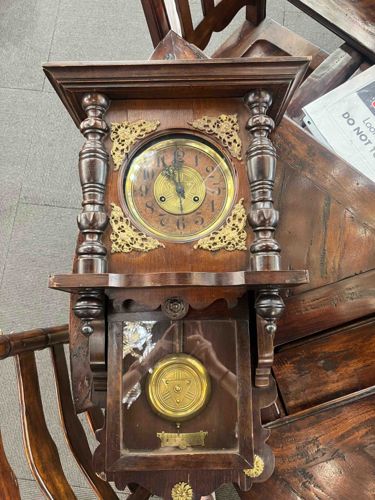
This is an antique wooden wall clock, likely made of a dark stained hardwood such as walnut or mahogany, exhibiting a Victorian or Edwardian aesthetic. The overall construction appears robust, featuring a rectangular upper section housing the clock face, surmounted by a stepped, prominent pediment with a decorative base. Flanking the clock face are two intricately turned columns with multiple ring and ball motifs, terminating in finials at the top and bottom. The clock face itself is enclosed behind a convex glass, revealing a metallic, possibly brass or gilded, dial plate with clear black Arabic numerals for hours and an inner ring showing minute markers. The hands are ornate, appearing to be black or darkened metal. Surrounding the clock face are four decorative, gilded brass or bronze spandrels, adding to its ornamental appeal. Below the clock face, the case transitions to a lower, rectangular section, which encloses the pendulum. This section features a glass panel at the front, allowing visibility of the brass-toned, ornate pendulum bob, which has a central design resembling a star or a stylized geometric pattern. Below the pendulum bob, a small, horizontal brass plate is visible, possibly a regulation adjustment. The overall condition shows signs of age, including some minor surface wear and scratches on the wood, consistent with an antique piece. The finish appears to have a rich patina. There are no immediately visible major damages such as cracks or chips, though a full assessment would require closer inspection. The gilded elements show minor tarnishing but retain their luster. The craftsmanship suggests a factory-produced piece of good quality, typical of late 19th to early 20th century domestic clocks. No specific maker's marks or signatures are discernible from the image, which would be crucial for a more precise identification and valuation. The presence of the pendulum indicates it is a mechanical movement clock.
AI Appraisal Report
Upon my virtual examination of this antique wooden wall clock, I observe a well-preserved piece, likely from the late 19th or early 20th century, consistent with Victorian or Edwardian design. The dark stained hardwood, ornate turned columns, and gilded spandrels suggest a factory-produced item of good quality for its period. The visible signs of age—minor surface wear and scratches on the wood, and slight tarnishing on the gilded elements—are consistent with its age and use, contributing to a desirable patina rather than detracting significantly from its appeal. I find no immediate evidence of major damage, suggesting it has been reasonably well-cared for.
In terms of market conditions, similar mechanical wall clocks from this era without significant maker's provenance typically appeal to collectors of antique horology or individuals seeking period decorative items. Demand is stable but not exceptionally high for unnamed pieces. Rarity is moderate; while not unique, each well-preserved example has its own appeal.
A key factor impacting value is the lack of a discernible maker's mark. Without this, it’s impossible to attribute it to a renowned clockmaker, which would significantly increase its value. Its aesthetic appeal and apparent good mechanical condition (implied by the intact pendulum system) are its primary drivers of value.
Authenticity verification from images alone has limitations. I can confirm its stylistic consistency with the stated period. However, a full authentication would require an in-person examination to verify the integrity of the movement, confirm the wood type and finish authenticity, assess the extent of any repairs, and search for hidden maker's marks. Provenance documentation, if available, would also be crucial. For instance, testing the metal composition of the gilded elements could confirm their material. This appraisal is based solely on the visual information provided.