AI estimate as of October 26, 2025 · verify with a professional before acting
AI-Generated · Verify before acting
Everything on this page is generated by AI for informational purposes only. AI can make mistakes — the AI may misidentify items or misattribute them (artist, maker, brand, designer, origin, era). This is not an official valuation and should not be used for insurance, sale, tax, estate, legal, or lending purposes — or any decision requiring a certified appraisal. It is not an authoritative claim about any person, brand, or rights holder — do not share or rely on it as a factual statement about a third party. Always consult qualified professionals before making financial decisions.
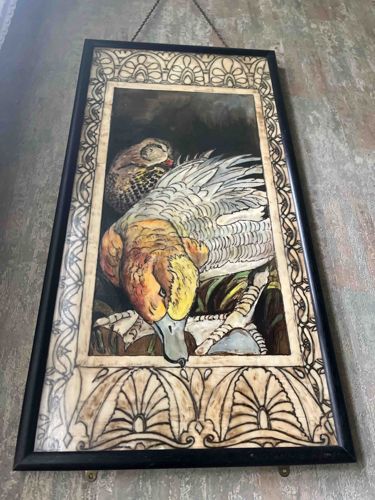
This item is a framed art panel featuring an intricate depiction of ducks, likely a drake and a hen, created through an incising, scrimshaw, or pigment-filled carving technique on what appears to be bone or a bone-like material. The main panel showcases a large drake in the foreground, characterized by a vibrant yellow head and chest, muted orange-brown back feathers, and distinctive grey-white wings with detailed feather rendering. Its head is lowered as if feeding or foraging, with a greyish-blue bill visible. In the background, partially obscured by the drake, is a smaller duck, likely a hen, with speckled brown and black plumage, resting or nesting. The background behind the ducks is dark and indistinct, suggesting a natural, perhaps aquatic, habitat. The central artwork is surrounded by a wide, elaborately decorated border that is also incised with a repeating pattern of stylized geometric and floral motifs, possibly resembling an Art Deco or Art Nouveau influence. This border features a lighter, creamy color, typical of bone, with the incised lines filled with a darker pigment to enhance visibility. The entire piece is encased in a simple, rectangular black wooden frame. The frame appears to be in good condition, as does the bone panel, with no obvious cracks, chips, or significant pigment loss visible from the provided images. The craftsmanship suggests a skilled hand, particularly in the detailed feather work and the precise geometric border. The piece exhibits a consistent aesthetic, implying it is either contemporary folk art or a piece from the early to mid-20th century, given the decorative border's style. The presence of a hanging wire indicates it is intended for wall display. The overall quality appears high, suggesting careful execution and attention to detail. Slight variations in color within the bone material are natural and contribute to its authenticity.
AI Appraisal Report
Based on my visual examination of the provided images, this framed incised bone art panel, depicting a drake and a hen, appears to be in very good overall condition. The bone panel itself shows no obvious cracks, chips, or significant pigment loss, and the incised lines seem crisp and well-defined. The black wooden frame also appears stable and in good condition. Authenticity, based on technique and material, leans towards either contemporary folk art or a piece from the early to mid-20th century, consistent with the Art Deco/Art Nouveau inspired border.
From the images, the craftsmanship is notably detailed, especially in the feather work and the precise geometric border, indicating a skilled hand. However, confirming the material as genuine bone versus a composite or synthetic material would require in-person examination. The specific type of bone (e.g., bovine, ivory substitute) would also affect value, and a blacklight test could help identify filler materials or repairs not visible to the naked eye. Provenance documentation, such as artist information, date of creation, or previous ownership, is currently unknown and would significantly impact value and authenticity confirmation.
In terms of market conditions, items of this nature often appeal to collectors of folk art, scrimshaw-style art, or decorative wildlife pieces. While not exceptionally rare, the quality of craftsmanship suggests it would attract interest. Demand for such detailed, unique pieces is generally steady for decorative art. Without physical inspection, specific material identification, or provenance, I must appraise this conservatively. For a full authentication, a physical examination, scientific testing of the material, and any available provenance documentation would be essential.
Considering these factors, I would place the appraisal value for this incised bone art panel in its current perceived condition and information known between $250 and $400.