AI estimate as of December 6, 2025 · verify with a professional before acting
AI-Generated · Verify before acting
Everything on this page is generated by AI for informational purposes only. AI can make mistakes — the AI may misidentify items or misattribute them (artist, maker, brand, designer, origin, era). This is not an official valuation and should not be used for insurance, sale, tax, estate, legal, or lending purposes — or any decision requiring a certified appraisal. It is not an authoritative claim about any person, brand, or rights holder — do not share or rely on it as a factual statement about a third party. Always consult qualified professionals before making financial decisions.
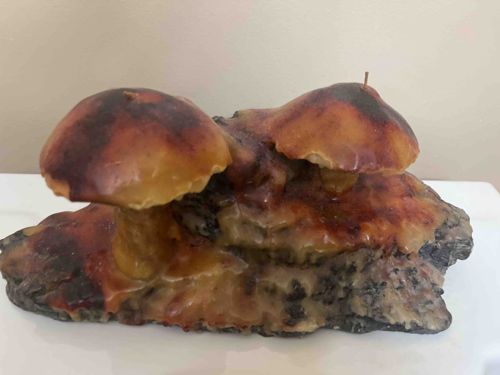
This item is a novelty candle designed to resemble a cluster of mushrooms growing from a piece of wood or forest floor detritus. The candle features two distinct mushroom forms with rounded caps and visible stems, set upon a rugged, undulating base. The overall color palette is organic and earthy, dominated by shades of brown, amber, and dark reddish-brown, mimicking natural fungi and decaying wood. The caps of the mushrooms exhibit a mottled pattern, with darker brownish-red patches against a lighter, translucent amber-brown wax, suggesting a variegated cap surface. One mushroom, positioned on the right, has a visible wick protruding from its apex, indicating its primary function as a candle. The wax itself appears to have a slightly glossy finish, possibly from a protective coating or the nature of the wax blend. The base of the candle is multi-layered, with an initial lighter, somewhat translucent layer of wax that flows into a darker, more opaque layer with textured, almost bark-like details in shades of grey and black. This detail aims to simulate the rough texture of a log or rocky earth. The construction suggests it was likely made from poured wax, potentially in a mold, with subsequent hand-finishing to create the varied textures and color effects. There are no visible maker's marks or signatures. Given its likely use as a decorative item and occasional candle, it's probably mid-to-late 20th century in style. The condition appears good, with no obvious signs of significant burning or damage to the wax, preserving its full sculptural form. The craftsmanship indicates a commercial production rather than a fine art piece, characteristic of decorative home goods.
AI Appraisal Report
I have visually examined the provided image of this novelty mushroom cluster candle, designed to mimic natural fungi growing from a forest floor. The condition appears to be very good, with no obvious signs of significant burning or damage to the wax, which is crucial for its decorative appeal. The sculptural form is intact, preserving its intended aesthetic.
Authenticity, in this context, refers to its identity as a commercially produced novelty candle. Based on the craftsmanship, which suggests poured wax and potentially hand-finishing for texture, I assess it as a mass-produced or small-batch item, characteristic of decorative home goods rather than a fine art piece. The organic color palette and detailed textures are consistent with mid-to-late 20th-century novelty candles of this type.
Market conditions for novelty candles are generally niche, driven by nostalgic appeal, specific decor styles (e.g., woodland, cabin core, or retro), and the item’s intact condition. Comparables seen at online auctions or vintage markets typically range from $15 to $50 for similar unused or minimally used decorative candles. Demand is moderate, appealing to collectors of vintage home decor or those seeking unique accent pieces. Rarity is not a significant factor here; while this specific design may not be ubiquitous, the category of novelty candles is quite common.
Factors impacting value include its excellent cosmetic condition, which allows it to function fully as a decorative piece. The vivid colors and detailed textures are well-preserved. There are no visible maker's marks, which is typical for such items and does not negatively impact its value, as these are rarely attributed to specific artists or manufacturers. The primary limitation in authenticity verification from an image alone is the inability to physically inspect the wax quality, detect any faint odors, or examine the integrity of the wick's embedment. An in-person examination could confirm wax type (e.g., paraffin, beeswax blend), and further assess its stability for potential burning, although its primary value is decorative. Provenance documentation or scientific testing would not typically be applicable or cost-effective for an item of this nature and value.