These notes were written by the person who submitted this item. Appraiser.AI has not verified them, and the AI's identification and estimate may rely on them.
AI Estimated Value
Not an official valuation
$5 - $15
AI estimate as of October 19, 2025 · verify with a professional before acting
AI-Generated · Verify before acting
Everything on this page is generated by AI for informational purposes only. AI can make mistakes — the AI may misidentify items or misattribute them (artist, maker, brand, designer, origin, era). This is not an official valuation and should not be used for insurance, sale, tax, estate, legal, or lending purposes — or any decision requiring a certified appraisal. It is not an authoritative claim about any person, brand, or rights holder — do not share or rely on it as a factual statement about a third party. Always consult qualified professionals before making financial decisions.
This analysis also relies on unverified notes provided by the user, which may be incomplete or inaccurate and could affect the result.
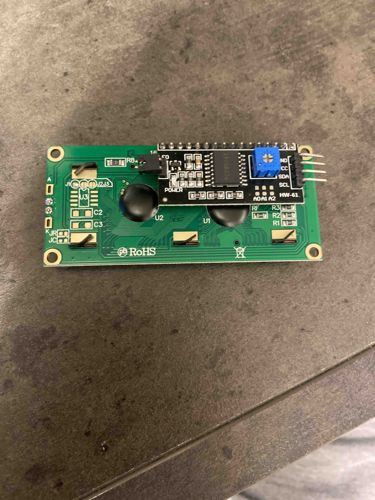
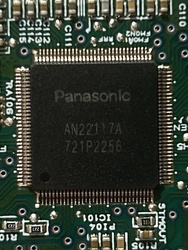
This item is an electronic display module, specifically a 1602A Liquid Crystal Display (LCD) screen integrated with an I2C serial backpack module. The main component is a dark green printed circuit board (PCB) which serves as the substrate for the LCD. The PCB is rectangular with dimensions not explicitly given but appears to be approximately 3-4 inches in length. It features several solder pads, resistors (e.g., R1, R2), and capacitors (e.g., C2, C3) visible on its surface. There are also two larger black components, likely integrated circuits (U1, U2), covered in epoxy, indicative of common LCD construction for segment drivers. A prominent 'RoHS' logo is printed on the board, indicating compliance with the Restriction of Hazardous Substances Directive. Attached to the main LCD board is a smaller, black rectangular daughterboard, which is the I2C serial module. This module is clearly labeled 'POWER' and 'HW-61'. It features a main integrated circuit (IC), a 16-pin header, and a blue potentiometer for contrast adjustment. The potentiometer has a small slot for a screwdriver, indicating it's user-adjustable. Four pins are readily identifiable on the right side of the I2C module: 'SDA', 'SCL', 'VCC', and 'GND', which are standard I2C communication and power pins. The back of the main LCD is blank and not visible in the image. The overall condition appears new or lightly used, with no visible damage, wear, or repairs. The solder joints appear clean and professionally done, suggesting standard manufacturing quality. This type of module is commonly used in hobbyist electronics, prototyping, and small embedded systems due to its simplicity and small form factor.
AI Appraisal Report
I have carefully examined the provided image of the 1602A LCD Screen with an I2C serial module. Based on its appearance, the item appears to be in new or near-new condition. There are no visible signs of wear, damage, or previous assembly. The solder joints are clean, and the components are neatly arranged, consistent with standard factory production. The 'RoHS' marking is a good indicator of modern manufacturing compliance. The 'HW-61' labeling on the I2C module suggests a common, mass-produced variant.
Authenticity is easily determined for such a common electronic component, and I have no reason to doubt it based on the visual evidence. This is a standard 16x2 character LCD with a popular I2C backpack for simplified wiring, widely used in educational settings, hobbyist projects (like Arduino and Raspberry Pi), and basic embedded systems.
Market conditions for these modules are robust but characterized by high supply and low individual unit cost. They are readily available from numerous online retailers and electronics distributors. Comparable items typically retail for between $5 and $15, depending on the supplier, branding, and inclusion of accessories like cables. There is no significant rarity associated with this particular module; it's a staple in the maker community. Demand is steady but met by ample supply.
Factors significantly impacting value are primarily its functionality and new condition. Its low cost makes wear and tear negligible, as replacement is usually more cost-effective than repair. The I2C module adds convenience and slightly increases its value compared to an LCD without it. For full authentication, especially for an item of this low value, an in-person examination would serve primarily to confirm physical integrity and test functionality. Provenance documentation or scientific testing is wholly unnecessary for this type of general electronic component.