AI Appraisal Estimate

AI-generated estimates · not official valuations

From the user

What was submitted

Photo and notes provided by the user — not generated by AI

Submitted item photo
Submitted photo · June 20, 2026

User's notes

No additional notes provided.

AI analysis below

AI appraisal

AI analysis & estimate

AI-Generated · Verify before acting

Everything below is generated by AI for informational purposes only. AI can make mistakes — the AI may misidentify items or misattribute them (artist, maker, brand, designer, origin, era). This is not an official valuation and should not be used for insurance, sale, tax, estate, legal, or lending purposes — or any decision requiring a certified appraisal. It is not an authoritative claim about any person, brand, or rights holder — do not share or rely on it as a factual statement about a third party. Always consult qualified professionals before making financial decisions.

Read the full disclaimer

AI Identification

·Not independently authenticated·Verify before acting

Series 1953/1963 United States Five Dollar Red Seal Legal Tender Notes

Numismatics / US Paper Currency

AI Estimated Value

·Not an official valuation·Verify before acting

$24.00 - $30.00

As of June 20, 2026

AI Item Analysis

·AI can make mistakes·Verify before acting
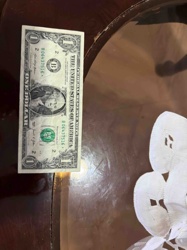
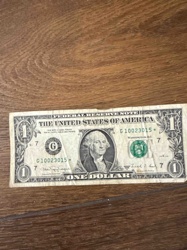
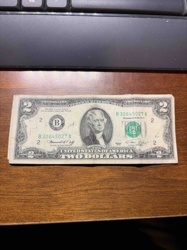
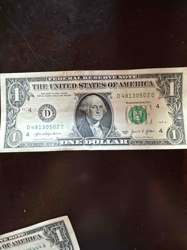
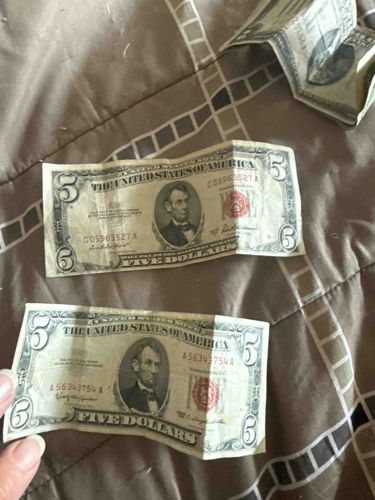
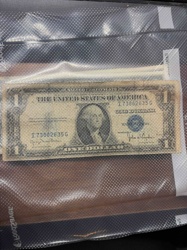
This collection consists of three United States five-dollar bills, specifically 'United States Notes' as indicated by the distinctive red treasury seal and red serial numbers. The central portrait features Abraham Lincoln within an oval frame. The notes are printed on characteristic linen-cotton blend paper with security fibers typical of mid-20th-century U.S. currency. Based on the visible design elements, these appear to be from the 1953 or 1963 series. Two notes are prominently displayed: one with serial number C 05963527 A and another with A 56343754 A. The condition of these specimens shows significant signs of circulation; all notes exhibit heavy vertical and horizontal folds, creasing, and rounded corners. There is visible surface soiling and minor edge fraying, particularly on the note held by the hand. The paper has lost its original crispness, appearing limp and somewhat darkened with age. These legal tender notes were issued directly by the U.S. Treasury rather than the Federal Reserve, a historical distinction marked by the red ink. Small size notes like these replaced larger 'horse blanket' currency in 1928 and were produced in this red-seal format until the late 1960s. The engraving remains legible, showing the intricate scrollwork and 'The United States of America' banner across the top.
AI Appraisal Report

·AI can make mistakes·Verify before acting
I have conducted a visual examination of these three United States Five Dollar Red Seal Legal Tender Notes. The collection includes specimens from the Series 1953 or 1963, identified by the distinctive red Treasury seal and serial numbers. Based on the provided imagery, the notes appear to be genuine currency produced by the Bureau of Engraving and Printing. However, the condition of these specific specimens is graded as 'Very Good' to 'Fine' at best. There is significant evidence of circulation, including heavy vertical and horizontal creasing, rounded corners, surface soiling, and a loss of paper crispness. Such wear is typical for 'pocket change' survivors of this era. From a numismatic perspective, Red Seal Five Dollar notes are historically significant as they were obligations of the U.S. Treasury rather than Federal Reserve Notes. Despite this history, they were printed in massive quantities (hundreds of millions). Consequently, circulated examples like these are very common in the current market. Comparable sales for circulated Series 1953/1963 $5 notes typically range from $8 to $10 per bill. High premiums are reserved only for 'Uncirculated' grades (MS63 and above) or specific star-note replacements, which these are not. While the design elements and fiber textures appear consistent with authentic mid-century currency paper, image-based appraisal has limitations. A physical inspection would be required to verify paper density, detect chemical cleaning, or identify subtle 'doctoring' of the edges. For definitive authentication, I would recommend checking for the presence of red and blue security fibers under magnification. Given the commonality of these notes, professional third-party grading (PMG/PCGS) is not financially warranted, as the cost of grading would exceed the market value of the notes themselves.

Get your items appraised

Instant estimates of your treasures with AI-powered appraisals

Browse More Appraisals