AI estimate as of October 14, 2025 · verify with a professional before acting
AI-Generated · Verify before acting
Everything on this page is generated by AI for informational purposes only. AI can make mistakes — the AI may misidentify items or misattribute them (artist, maker, brand, designer, origin, era). This is not an official valuation and should not be used for insurance, sale, tax, estate, legal, or lending purposes — or any decision requiring a certified appraisal. It is not an authoritative claim about any person, brand, or rights holder — do not share or rely on it as a factual statement about a third party. Always consult qualified professionals before making financial decisions.
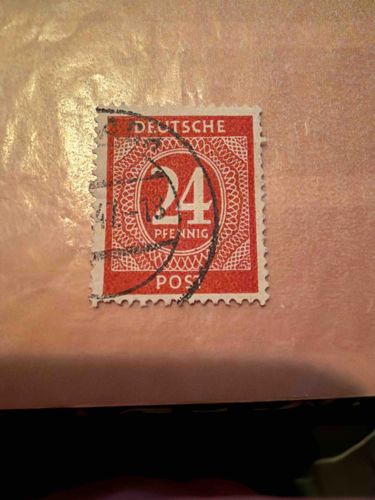
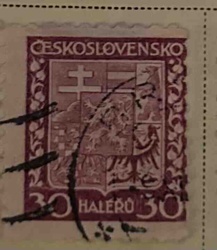
This item is a used postage stamp from the German Empire, specifically an issue from the 'Germania' series. The stamp is rectangular with perforated edges, indicative of its detachment from a larger sheet. Its primary color is a rich red, featuring a central design within a decorative border. The central motif is a circular pattern with a large numeral '24' prominently displayed, signifying its face value in Pfennig. Below the numeral '24', the word 'PFENNIG' is visible, confirming the denomination. Above the central circle, the word 'DEUTSCHE' is printed, and below it, 'POST', clearly identifying its origin and use for postal services. The decorative border around the central design appears to be composed of intricate, interlacing lines or filigree work, possibly a guilloche pattern, adding to its visual complexity. The overall condition shows signs of use, primarily a black circular postmark partially obscuring the '24' and 'PFENNIG' denomination, extending across the center and slightly upwards to the left. This postmark signifies that the stamp has been used for mailing and canceled. The perforations appear largely intact, though some minor wear or flattening might be present along the edges due to handling or removal. There are no immediately obvious tears or major creases visible in the image, suggesting a relatively well-preserved condition for a used stamp. The paper itself shows a slight sheen, possibly due to the lighting or the nature of the paper. This stamp likely dates to the early 20th century, given the 'Germania' series' issuance period. The craftsmanship is typical of national postal stamps, featuring precise printing and perforation, although the specific quality of the paper stock and ink cannot be fully assessed from the image alone.
AI Appraisal Report
I have visually examined the provided image of a German Empire 'Germania' 24 Pfennig postage stamp. This 24 Pfennig denomination, in the described red color, is part of the extensive and popular Germania series. Authenticity, based solely on the image, appears strong as the design elements align with known examples of this issue. However, absolute authentication would require an in-person examination for paper type, watermark (if any), and printing characteristics. The condition is key here. While the perforations appear largely intact, the heavy black circular postmark largely obscuring the '24 PFENNIG' denomination significantly impacts its aesthetic appeal and thus its value. While some collectors appreciate period cancellations, this one is rather heavy and detracts more than it adds. There are no visible tears or major creases, which is a positive. Market conditions for common Germania issues, especially heavily canceled examples like this, are generally robust but with a large supply. Demand tends to be higher for unused examples or those with light, neat cancellations that preserve the design. Rarity for this particular denomination and color is low to moderate in used condition. Factors impacting value are primarily the heavy cancellation, which reduces its appeal compared to a lightly canceled or unused example. Without physical inspection, I cannot ascertain gum condition (if unused), specific paper thickness, or confirm genuine perforations versus altered ones. A better assessment of centering, which affects value, is also difficult with the current image quality. For full authentication, I would need to physically inspect the stamp to check for watermarks, paper authenticity, printing methods, and to verify the cancellation's authenticity. Given the commonality of the issue and the relatively heavy cancellation, I place its appraised value at the lower end of the spectrum for a collectible, used Germania stamp.