AI Appraisal Estimate

AI-generated estimates · not official valuations

From the user

What was submitted

Photo and notes provided by the user — not generated by AI

Submitted item photo
Submitted photo · June 28, 2026

User's notes

German painting, unknown painter. Before the 1970s.

AI analysis below

AI appraisal

AI analysis & estimate

AI-Generated · Verify before acting

Everything below is generated by AI for informational purposes only. AI can make mistakes — the AI may misidentify items or misattribute them (artist, maker, brand, designer, origin, era). This is not an official valuation and should not be used for insurance, sale, tax, estate, legal, or lending purposes — or any decision requiring a certified appraisal. It is not an authoritative claim about any person, brand, or rights holder — do not share or rely on it as a factual statement about a third party. Always consult qualified professionals before making financial decisions.

Note

This analysis also relies on unverified notes provided by the user, which may be incomplete or inaccurate and could affect the result.

Read the full disclaimer

AI Identification

·Not independently authenticated·Verify before acting

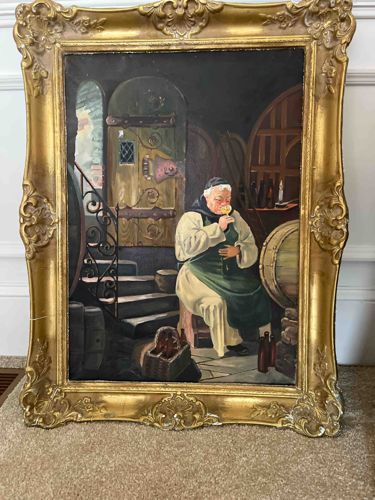
Mid-20th Century German Monk Wine Tasting Genre Painting

Fine Art - Oil Paintings

AI Estimated Value

·Not an official valuation·Verify before acting

$400 - $600

As of June 28, 2026

AI Item Analysis

·AI can make mistakes·Verify before acting
This is an original oil painting on canvas, likely of German origin, depicting a classic genre scene of a monk tasting wine in a cellar. The central figure is an elderly monk dressed in cream robes with a green apron and a dark skullcap, seated and intently examining a glass of white wine. The composition is rich with narrative detail, including large wooden wine casks, stone steps with wrought iron railings, and a heavy arched wooden door in the background. The lighting is focused on the figure, creating a dramatic chiaroscuro effect against the dark, subterranean environment. The painting is housed in a substantial, ornate gilded Rococo-style frame featuring elaborate scrolling acanthus leaves and shell motifs. The brushwork appears deliberate and illustrative, consistent with mid-20th-century commercial or souvenir art found in Europe. Visible condition issues include minor abrasions to the canvas surface and significant losses or 'foxing' on the bottom edge of the gilded frame where the plaster or gesso has chipped away. The frame shows a rich golden patina with some accumulated dust in the deep recesses. This piece exemplifies the popular 19th and 20th-century European tradition of depicting monastic life through humorous or peaceful daily activities.
AI Appraisal Report

·AI can make mistakes·Verify before acting
I have virtually examined this mid-20th-century German genre painting. The work depicts a familiar monastic trope—the wine-tasting monk—popularized by artists like Eduard von Grützner. This specific example appears to be a mid-century commercial or 'souvenir' execution rather than a 19th-century masterwork. The brushwork is competent and decorative, though it lacks the fine glazes and anatomical precision of high-period academic art. The lighting creates a pleasing atmospheric effect, which maintains the piece's appeal for traditional interior decor. Condition-wise, the canvas shows minor abrasions, and the frame exhibits significant gesso loss and chipping along the bottom edge, which detracts from the immediate retail value. In the current market, decorative genre scenes of this nature remain steady but common. Comparable works from unknown German studios of the 1950s typically sell at auction in the $300 to $700 range, depending on the condition of the elaborate gilt frames. The absence of a signature limits the investment potential, as much of the value in this category is driven by attribution. Because this appraisal is based on digital images, I cannot verify the exact age of the canvas, the presence of overpainting, or use UV light to detect hidden signatures. A full authentication would require an in-person physical inspection to examine the stretchers, verify the age of the pigments, and review any provenance documentation or gallery labels on the reverse. For insurance purposes, the replacement value reflects its high decorative quality and the cost of the ornate, albeit damaged, framing.

Get your items appraised

Instant estimates of your treasures with AI-powered appraisals

Browse More Appraisals