AI estimate as of October 27, 2025 · verify with a professional before acting
AI-Generated · Verify before acting
Everything on this page is generated by AI for informational purposes only. AI can make mistakes — the AI may misidentify items or misattribute them (artist, maker, brand, designer, origin, era). This is not an official valuation and should not be used for insurance, sale, tax, estate, legal, or lending purposes — or any decision requiring a certified appraisal. It is not an authoritative claim about any person, brand, or rights holder — do not share or rely on it as a factual statement about a third party. Always consult qualified professionals before making financial decisions.
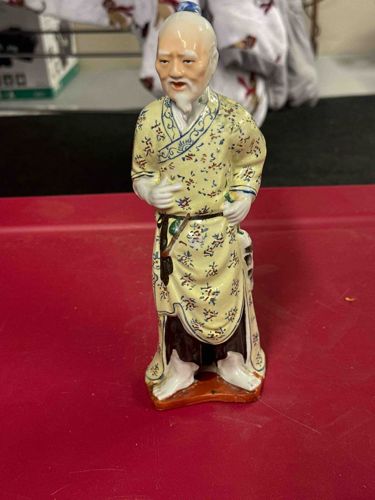
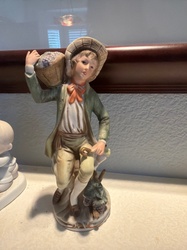
This item is a decorative porcelain figurine depicting an elderly Chinese 'wise man' or scholar. The figure stands upright, dressed in traditional robes. His face features a pale skin tone, a prominent white beard and mustache, and finely painted facial features including eyes with dark pupils and well-defined eyebrows. He is bald on top with a visible blue top knot or hair bun at the back of his head, indicating a specific style or status. The primary garment is a long-sleeved robe or tunic, painted in a light yellow or cream color adorned with numerous small, scattered patterns resembling Chinese characters or floral motifs in blue and black. The trim around the neck and cuffs of the robe features a more elaborate blue scrollwork design. Beneath the yellow robe, darker trousers or an undergarment in brown or dark black are visible. His hands, also pale, are positioned at his waist, one possibly holding a small object (though not clearly discernible). The figure is standing on an irregularly shaped, reddish-brown base, possibly imitating natural earth or a low pedestal. There are visible signs of wear consistent with age, particularly on the base where the paint appears chipped or faded, and possibly minor scuffing on the figure itself. The craftsmanship suggests a hand-painted piece, with some variations in the detail and consistency of the patterns, indicating its handmade nature. This style of figurine often dates from the early to mid-20th century, typically associated with export ware. The overall condition appears fair, with no immediately obvious major cracks or repairs, though closer inspection would be required to confirm this. It represents a common motif in Asian decorative arts, often symbolizing wisdom, longevity, or prosperity.
AI Appraisal Report
Based on my visual examination of the provided image, this Chinese Porcelain Wise Man Figurine appears to be a decorative export ware piece, likely dating from the early to mid-20th century. The hand-painted details, visible brushstrokes, and slight inconsistencies in the patterns are characteristic of such handmade items. The choice of a pale skin tone, prominent white beard, and traditional robes, along with the distinct blue top knot, are consistent with depictions of Chinese scholars or wise men from that period.
The condition appears fair. While there are no immediately obvious major cracks or repairs, I observe significant paint chipping and fading on the reddish-brown base and potential scuffing on the figure itself. These are common signs of age and handling for porcelain items of this vintage. Without a physical inspection, however, I cannot definitively rule out hairline cracks, professional repairs, or more subtle condition issues.
In terms of market conditions, figurines of this type are relatively common. While they hold decorative appeal, they are not particularly rare. High-end examples by renowned artists or from historically significant kilns command higher prices, but this piece appears to fall into the general decorative category. Comparables often sell in the $20-$100 range, depending significantly on exact age, condition, and artistic merit. The demand is moderate, driven primarily by collectors of Asian decorative arts or individuals seeking accent pieces.
Factors impacting value include the visible wear, which slightly detracts, and the lack of a discernible maker's mark or artist's signature, which would significantly enhance its authenticity and value. For full authentication and a more precise dating, an in-person examination would be critical to assess the porcelain body, glaze, and painting techniques under magnification, and to search for any hidden marks. Provenance documentation, if available, would also be invaluable. Without these, the current valuation remains an informed estimate based on visual cues alone.