AI estimate as of August 12, 2025 · verify with a professional before acting
AI-Generated · Verify before acting
Everything on this page is generated by AI for informational purposes only. AI can make mistakes — the AI may misidentify items or misattribute them (artist, maker, brand, designer, origin, era). This is not an official valuation and should not be used for insurance, sale, tax, estate, legal, or lending purposes — or any decision requiring a certified appraisal. It is not an authoritative claim about any person, brand, or rights holder — do not share or rely on it as a factual statement about a third party. Always consult qualified professionals before making financial decisions.
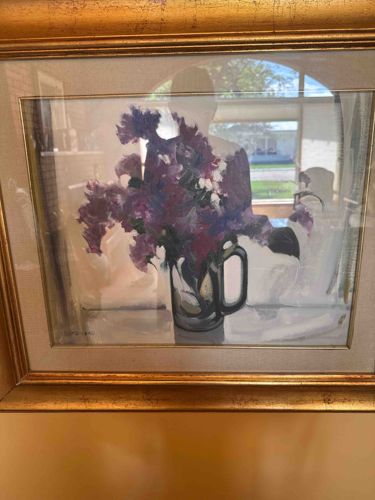
The item is a framed piece of artwork, likely a painting, featuring a still life composition of purple flowers in a dark, possibly metallic, pitcher or mug. The artwork itself uses broad, impressionistic brushstrokes, particularly evident in the depiction of the flowers which are rendered in various shades of purple, magenta, and subtle whites, giving them a somewhat abstract yet recognizable floral form. The vessel holding the flowers appears to have a reflective surface, indicating it could be ceramic, glass, or metal, depicted in dark grays and blacks with lighter highlights. The background of the painting seems to be a light, possibly off-white or very pale gray, suggesting an interior setting. There are reflections on the glass covering the artwork, indicating it is glazed, and these reflections show elements of the surrounding room, including what appears to be a window or arched opening. The frame is a prominent feature, crafted from wood with a gilded, antique gold finish. The gold leaf or paint shows signs of some wear and light distressing, typical of aged frames, contributing to a rustic or vintage aesthetic. The inner edge of the frame appears to have a subtle matte or linen liner in a light, neutral color, possibly cream or beige, which provides a border between the artwork and the ornate gold frame. The overall condition of the visible frame appears good, with a desirable patina. No visible artist's signature or specific manufacturing marks are discernible from the provided image. Based on the style of the painting and the frame, it could date from the mid-to-late 20th century or possibly early 21st century, leaning towards a more contemporary interpretation of traditional still life.
AI Appraisal Report
Upon visual examination of this Framed Still Life Painting: Purple Flowers in a Pitcher, I note its good overall condition, particularly regarding the frame with its desirable aged patina. The painting's impressionistic style, featuring broad brushstrokes and vibrant purple tones, suggests a contemporary rendering of a traditional subject. However, I must state that an authenticity verification from images alone has significant limitations. Without a visible artist's signature, direct attribution is impossible. Physical inspection would be critical to assess the medium's quality (oil, acrylic), canvas condition, and the presence of any hidden signatures or artist marks. The reflections on the glazing obscure details of the artwork's surface and condition. Market conditions for decorative still life paintings of this type are generally stable, with demand driven by interior design trends. While not rare, a well-executed piece in good condition with a complementary frame can command fair prices. Comparable decorator art pieces often fall into the mid-hundreds, particularly when framed appealingly. Factors significantly impacting value include the potential identification of a listed artist (which would dramatically increase value), the actual age of the artwork, and the construction quality of the frame. To fully authenticate and accurately value this piece, an in-person examination is essential. This would allow for detailed inspection of the brushwork, surface texture, identification of the specific medium, and thorough examination of the frame's construction. Provenance documentation, such as purchase receipts or exhibition history, would also be invaluable for establishing authenticity and a more precise valuation.