AI identification & appraisal estimate

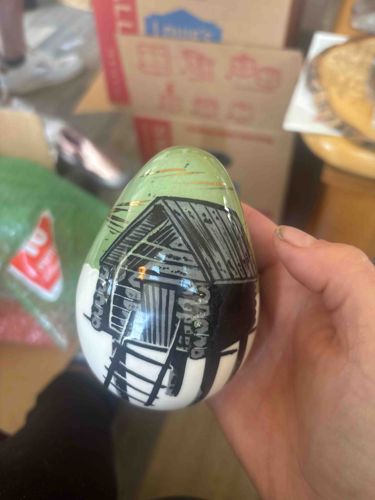
Decorative Ceramic Egg with Rustic Building Design

Submitted photo of Decorative Ceramic Egg with Rustic Building Design
Photo submitted by the user — not generated by AI

User's notes

Salt and pepper shaker

These notes were written by the person who submitted this item. Appraiser.AI has not verified them, and the AI's identification and estimate may rely on them.

AI Estimated Value

Not an official valuation

$3-8

AI estimate as of July 22, 2025 · verify with a professional before acting

AI-Generated · Verify before acting

Everything on this page is generated by AI for informational purposes only. AI can make mistakes — the AI may misidentify items or misattribute them (artist, maker, brand, designer, origin, era). This is not an official valuation and should not be used for insurance, sale, tax, estate, legal, or lending purposes — or any decision requiring a certified appraisal. It is not an authoritative claim about any person, brand, or rights holder — do not share or rely on it as a factual statement about a third party. Always consult qualified professionals before making financial decisions.

This analysis also relies on unverified notes provided by the user, which may be incomplete or inaccurate and could affect the result.

Read the full disclaimer

AI Item Analysis

This appears to be a decorative ceramic egg, possibly intended for display during holidays such as Easter, or as a collectible. Its physical characteristics include an egg-shaped form, approximately 2-3 inches in height judging by the hand holding it. The base material is likely ceramic or porcelain, finished with a glossy glaze. The color palette is dominated by white on the lower portion, transitioning to a light green/mint green at the top. A distinct black and white graphic design, resembling a stylized building or shed, wraps around the mid-section of the egg. This design utilizes strong vertical and horizontal lines, giving it a somewhat architectural or rustic aesthetic. Notable features include what appears to be gold or metallic accents in thin lines at the transition point between the white and green sections, near the top, adding a touch of elegance. There are no readily apparent manufacturer's marks or signatures visible in the provided image. The condition seems good, with no obvious chips, cracks, or significant wear visible, though the reflective surface makes it difficult to assess minor imperfections. The craftsmanship appears to be of reasonable quality, with crisp lines in the graphic design. Without a maker's mark or additional context, estimating the exact age is challenging, but the style of graphic design suggests it could be mid-20th century to contemporary. It's a unique piece due to its specific graphic illustration on an egg form.
AI Appraisal Report

Upon examining the provided image, this item, initially appearing as a single decorative egg, has been identified by the owner as a salt or pepper shaker. It is a ceramic piece, approximately 2-3 inches tall, with a glossy glaze. The design features a two-tone white and light green body, separated by a gold-accented band, with a black and white graphic resembling a rustic building. The craftsmanship appears to be of good, likely mass-produced, quality. The condition in the image is good, showing no obvious chips or cracks. The identification as a shaker significantly alters its market category from a singular decorative object to functional tableware, often sold in pairs. As a single shaker, its value is diminished. The rustic, stylized design suggests a mid-to-late 20th-century origin, possibly from the 1970s or 1980s. The market for individual, unmarked ceramic shakers from this era is generally modest. Comparable single shakers of similar vintage and non-specific branding typically sell for low prices in online marketplaces and antique malls. The primary value driver would be finding a collector seeking this specific shaker to complete a pair, which is a niche demand. Without physical inspection, I cannot confirm the maker, country of origin, or check for hairline cracks or wear on the glaze and gold trim. A full authentication would require examining the base for any manufacturer's marks and inspecting the shaker holes and stopper to better identify its specific production run.

Keep exploring

More decorative arts appraisals

Get your items appraised

Instant AI-powered appraisal estimates from a photo

Browse More Appraisals