AI estimate as of November 9, 2025 · verify with a professional before acting
AI-Generated · Verify before acting
Everything on this page is generated by AI for informational purposes only. AI can make mistakes — the AI may misidentify items or misattribute them (artist, maker, brand, designer, origin, era). This is not an official valuation and should not be used for insurance, sale, tax, estate, legal, or lending purposes — or any decision requiring a certified appraisal. It is not an authoritative claim about any person, brand, or rights holder — do not share or rely on it as a factual statement about a third party. Always consult qualified professionals before making financial decisions.
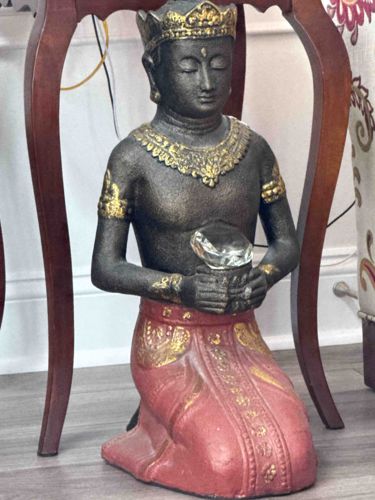
This item is a kneeling statue, likely crafted from a cast heavy material such as resin, concrete, or a composite, designed to emulate the appearance of weathered bronze or stone. It depicts a figure, possibly a Buddha or Bodhisattva, adorned with traditional Thai-style regalia. The figure is shown kneeling on both knees, with hands clasped together at waist level, holding a clear, faceted object, possibly a crystal orb or jewel.
The statue's upper body and head are finished in a dark, metallic bronze or dark gray color, with significant gold painted accents highlighting details such as the crown, necklace, armbands, and the borders of the garment. The crown is elaborately detailed with multiple golden peaks. The face is serene, with closed eyes, a gentle smile, and elongated earlobes indicative of Buddhist iconography. A small, circular 'urna' mark is visible between the eyebrows, also in gold. The lower body is draped in a reddish-pink garment, possibly simulating silk or fabric, with gold patterned embellishments, some of which appear to be raised or embossed, adding texture and depth. The garment shows a ribbed or pleated design on the lower part, suggesting fabric folds.
In terms of condition, the statue appears relatively well-preserved, though some areas, particularly the gold paint, exhibit minor wear or rubbing, consistent with handling or age. There are no major visible cracks or chips, suggesting robust construction. The overall style suggests an piece intended for decorative use, likely dating from the late 20th or early 21st century, designed to evoke a sense of spiritual tranquility and exotic aesthetic. The craftsmanship is moderately detailed, with attention given to facial features and decorative elements, indicating a mass-produced item with good quality control.
AI Appraisal Report
I have examined the provided image of the Kneeling Thai-Style Buddha Statue with Crystal Orb. Based on its appearance, this statue is likely a decorative item made from a cast heavy material such as resin, designed to mimic weathered bronze or stone. The condition appears good, with minor wear to the gold accents consistent with age and handling. There are no obvious chips or cracks visible from the image.
This piece is consistent with mass-produced decorative items from the late 20th to early 21st century, targeting the home decor market. The craftsmanship, while detailed, does not suggest an antique or artist-signed original work. Market comparables for similar new or used decorative Buddha statues of this size and material typically range from $50 to $150. While attractive, these items are not rare, and there is a steady but not exceptionally high demand for them among individuals seeking spiritual or exotic accents for their homes.
The primary factors impacting value are its decorative appeal and good condition. The material (likely resin) and probable mass-production limit its appreciation as a fine art or antique piece.
Limitations exist in verifying authenticity purely from images. A physical examination would be necessary to confirm the exact material composition, assess the internal structure for any hidden damage, and determine manufacturing techniques more precisely. Without provenance documentation, it's impossible to confirm its exact origin or age beyond a general stylistic assessment. Scientific testing could verify material composition if there were any doubt, but for a decorative item of this nature, such testing is generally not cost-effective or warranted.