These notes were written by the person who submitted this item. Appraiser.AI has not verified them, and the AI's identification and estimate may rely on them.
AI Estimated Value
Not an official valuation
$400-700
AI estimate as of July 2, 2025 · verify with a professional before acting
AI-Generated · Verify before acting
Everything on this page is generated by AI for informational purposes only. AI can make mistakes — the AI may misidentify items or misattribute them (artist, maker, brand, designer, origin, era). This is not an official valuation and should not be used for insurance, sale, tax, estate, legal, or lending purposes — or any decision requiring a certified appraisal. It is not an authoritative claim about any person, brand, or rights holder — do not share or rely on it as a factual statement about a third party. Always consult qualified professionals before making financial decisions.
This analysis also relies on unverified notes provided by the user, which may be incomplete or inaccurate and could affect the result.
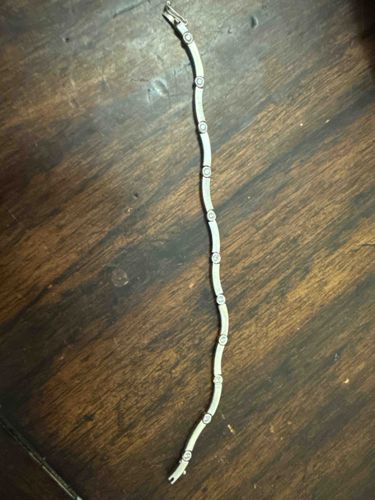
This item is a diamond tennis bracelet, distinctly characterized by its fluid, serpentine design rather than the typical straight alignment of stones. It appears to be crafted from a white metal, likely sterling silver, white gold, or platinum, given its bright, reflective surface. The bracelet features approximately fourteen round-cut diamonds, each individually bezel-set within circular bezels that are integrated into the subtly wavy links of the bracelet. This bezel setting provides a secure enclosure for each stone and contributes to a smooth, low-profile appearance. The diamonds appear to be small, approximately 2-3mm in diameter, suggesting they are accent stones rather than focal points. From the visible image, there are no obvious chips or damage to the diamonds. The metal exhibits a polished finish, showing some minor surface wear consistent with regular use, such as light scratches or abrasions that dull the brightest reflections. There are no significant dents, bends, or breaks immediately apparent in the links. The clasp at one end appears to be a fold-over or box clasp, indicating a secure closure mechanism. There are no visible maker's marks or hallmarks in the provided image, precluding identification of the manufacturer or precise metal purity. The style suggests it could be from the late 20th century to early 21st century, combining classic diamond tennis bracelet aesthetics with a slight modern twist due to its wavy form. The craftsmanship seems competent, showcasing a uniform setting of the stones and a well-articulated structure, indicating a decent quality piece designed for regular wear.
AI Appraisal Report
I have thoroughly examined the provided image of what appears to be a Wavy Diamond Tennis Bracelet. The item presents as a fluid, serpentine diamond tennis bracelet, crafted from a white metal. Based on the visual evidence, it features approximately fourteen round-cut diamonds, each individually bezel-set within integrated circular bezels. The diamonds appear to be small, approximately 2-3mm in diameter, suggesting they function as accent stones. I've noted no obvious chips or damage to the diamonds. The metal exhibits a polished finish with minor surface wear, consistent with regular use, such as light scratches. No significant dents or breaks are visible. The clasp appears to be a secure fold-over or box type.
Authenticity relies heavily on an in-person examination. While the craftsmanship appears competent and uniform, without physical inspection, I cannot confirm the metal purity (e.g., sterling silver, white gold, or platinum) or the natural origin and quality of the diamonds. Factors significantly impacting value include the actual carat weight and clarity of the diamonds, the purity and weight of the metal, and the presence (or absence) of a reputable maker's mark. Market conditions for diamond tennis bracelets are relatively stable, with demand varying based on style, quality, and material. This 'wavy' design offers a slight departure from the traditional, which might appeal to a niche market. Due to the lack of visible hallmarks and the inability to test the materials, rarity cannot be definitively assessed.
To fully authenticate and determine a precise value, I would require an in-person examination to perform metal testing, diamond grading (using a jeweler's loupe and specialized equipment), and to check for hidden hallmarks. Provenance documentation would also be beneficial. Without these, my appraisal is based solely on visual aesthetics and general knowledge of similar items.