AI Appraisal Estimate

AI-generated estimates · not official valuations

From the user

What was submitted

Photo and notes provided by the user — not generated by AI

Submitted item photo
Submitted photo · June 8, 2026

User's notes

No additional notes provided.

AI analysis below

AI appraisal

AI analysis & estimate

AI-Generated · Verify before acting

Everything below is generated by AI for informational purposes only. AI can make mistakes — the AI may misidentify items or misattribute them (artist, maker, brand, designer, origin, era). This is not an official valuation and should not be used for insurance, sale, tax, estate, legal, or lending purposes — or any decision requiring a certified appraisal. It is not an authoritative claim about any person, brand, or rights holder — do not share or rely on it as a factual statement about a third party. Always consult qualified professionals before making financial decisions.

Read the full disclaimer

AI Identification

·Not independently authenticated·Verify before acting

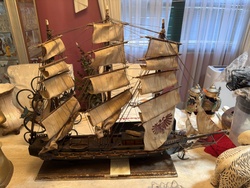
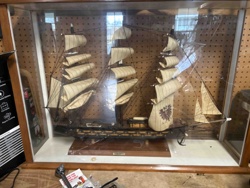
Santa Maria 1492 Wooden Ship Model

Maritime Collectibles / Scale Models

AI Estimated Value

·Not an official valuation·Verify before acting

$150 - $250

As of June 8, 2026

AI Item Analysis

·AI can make mistakes·Verify before acting
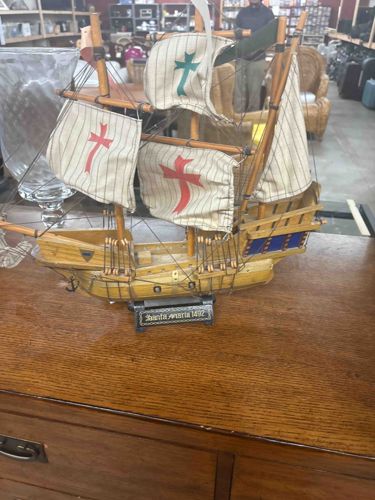
This is a detailed wooden scale model of the Santa Maria, Christopher Columbus's flagship from his 1492 voyage. The model is constructed primarily of light-toned wood, likely pine or basswood, and features a multi-masted design with fabric sails. The sails are off-white with vertical pinstripes and are prominently decorated with red and teal tempered crosses, reflecting the iconography of the Spanish exploration period. The hull is built using a plank-on-frame style, showing visible horizontal seams and small circular dark accents representing portholes or rivets. A blue-painted transom at the stern adds a decorative touch. The rigging is intricate, utilizing thin black cordage to represent shrouds, stays, and halyards, though some lines appear slightly slack or tangled due to age. A small anchor ornament hangs from the bow. The ship is mounted on a black display stand featuring a silver-toned plaque that reads 'Santa Maria 1492' in a gothic script. The overall condition is fair to good; there is visible dust accumulation across the rigging and deck, and the fabric of the sails shows slight yellowing consistent with vintage decorative items from the mid-to-late 20th century. The craftsmanship is commensurate with mid-tier hobbyist kits or commercial decor pieces intended for display in libraries or nautical-themed rooms.
AI Appraisal Report

·AI can make mistakes·Verify before acting
Upon visual examination of this Santa Maria scale model, I find it to be a representative example of a commercial hobbyist kit or a mass-produced nautical decor piece, likely dating from the 1960s to the 1980s. The plank-on-frame construction is consistent with mid-tier craftsmanship; however, the use of basic softwoods and the simplistic design of the rigging suggest a decorative rather than professional museum-grade specimen. The condition is fair, noting visible dust accumulation, slack rigging, and age-related oxidation on the nameplate. The pinstriped fabric sails show characteristic yellowing, which confirms its vintage status but does not add significant rarity. Market demand for these types of mid-century maritime models remains steady but modest, primarily driven by interior designers and nautical enthusiasts looking for library or study accents rather than serious investment-grade collectors. Comparables for such mass-produced kits (e.g., Constructo or Artesania Latina) often sell within the $100-$300 range depending on the hobbyist's skill level. A major factor limiting the value is the lack of custom detail and the 'kit' appearance of the blue transom and standard metal anchor. Authenticity verification is limited through digital imagery alone; a physical inspection is required to determine if the hull is truly solid wood or composite, and to check for structural integrity beneath the dust. Full authentication would require provenance documentation or original assembly manuals to confirm the manufacturer and time period accurately.

Get your items appraised

Instant estimates of your treasures with AI-powered appraisals

Browse More Appraisals