AI estimate as of October 27, 2025 · verify with a professional before acting
AI-Generated · Verify before acting
Everything on this page is generated by AI for informational purposes only. AI can make mistakes — the AI may misidentify items or misattribute them (artist, maker, brand, designer, origin, era). This is not an official valuation and should not be used for insurance, sale, tax, estate, legal, or lending purposes — or any decision requiring a certified appraisal. It is not an authoritative claim about any person, brand, or rights holder — do not share or rely on it as a factual statement about a third party. Always consult qualified professionals before making financial decisions.
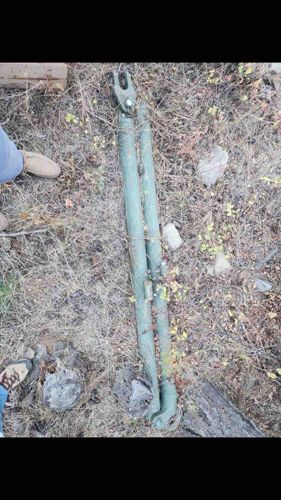
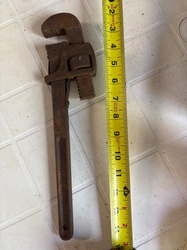
The item depicted is a pair of heavy-duty cable cutters, characterized by their robust construction and significant wear. These cutters feature two long, tubular handles, approximately 2-3 feet in length, that are coated in a faded, heavily weathered greenish-blue paint or industrial coating. The paint shows considerable chipping, scratching, and discoloration, indicating prolonged exposure to the elements and frequent use. The handles are connected at one end to the cutting head, which appears to be made of a thick, dark gray or black metal, likely steel, designed for shearing through thick cables or rods. One critical feature of the cutting head is a pin that fastens the two jaws together, allowing them to pivot and close. This pin shows some surface oxidation suggesting it is made of steel. The cutting blades themselves are not clearly visible in an open position but appear to be substantial for their intended purpose. There is a notable amount of dirt, grime, and possibly rust accumulating in the crevices and along the surfaces, especially where the paint has worn away. Small pieces of plant debris, including dried leaves and twigs, are entangled around the handles, further emphasizing their outdoor storage and neglected condition. The overall appearance suggests a tool designed for industrial or heavy-duty construction use, built to withstand significant force and harsh environments. Given the degree of tarnish, weathering, and lack of visible manufacturer's marks, it is difficult to ascertain the exact age, but the item appears to be several decades old, possibly from the mid to late 20th century. The craftsmanship, while functional, prioritizes durability and strength over aesthetic refinement. No immediate repairs are evident, but the wear indicates a history of rugged application.
AI Appraisal Report
Based on my remote visual examination of the provided image, I can assess these heavy-duty cable cutters. The condition is heavily used, showing significant wear, chipping, scratching, and discoloration of the greenish-blue paint on the long tubular handles. The cutting head, likely steel, shows surface oxidation on the fastening pin, and general dirt, grime, and possibly rust are evident throughout, especially in crevices and worn areas. The presence of plant debris further suggests outdoor storage and neglect. This visual evidence points to a tool whose functional lifespan is likely waning, though its robust construction suggests it was initially built for durability. Authenticity as a heavy-duty cable cutter is clear, given its form and apparent function; however, specific manufacturer, model, or age cannot be determined from images alone due to the absence of visible marks. These are typical of industrial or construction tools from the mid to late 20th century. In terms of market conditions, used heavy-duty cable cutters of this apparent vintage and condition generally command a low price. They are not rare items, and while essential for specific tasks, there isn't a high demand for well-worn, older examples unless they are from a highly collectible brand, which cannot be ascertained here. Factors significantly impacting value downwards are the extreme wear, lack of clear manufacturer identification, and the potential need for significant cleaning or maintenance. From images alone, I cannot assess the sharpness or integrity of the cutting blades, nor the smooth operation of the pivoting mechanism, which could further impact value. For full authentication and a more precise valuation, an in-person examination would be crucial to inspect blade condition, functionality, and search for any hidden manufacturer marks.