AI estimate as of October 27, 2025 · verify with a professional before acting
AI-Generated · Verify before acting
Everything on this page is generated by AI for informational purposes only. AI can make mistakes — the AI may misidentify items or misattribute them (artist, maker, brand, designer, origin, era). This is not an official valuation and should not be used for insurance, sale, tax, estate, legal, or lending purposes — or any decision requiring a certified appraisal. It is not an authoritative claim about any person, brand, or rights holder — do not share or rely on it as a factual statement about a third party. Always consult qualified professionals before making financial decisions.
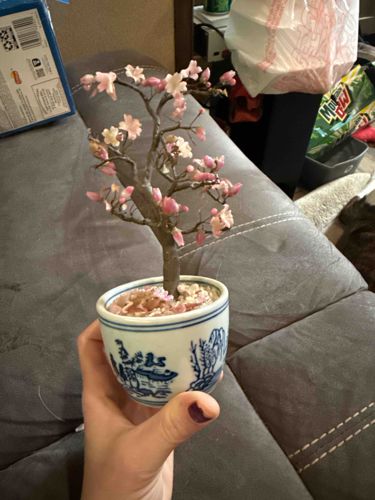
This item is a decorative miniature faux cherry blossom bonsai tree, skillfully crafted to mimic the appearance of a blossoming 'Sakura' tree. The tree features numerous delicate pink and off-white blossoms made from what appears to be a resin, plastic, or possibly carved shell or stone material, attached to a naturalistic brown 'trunk' and branching system. The trunk and branches exhibit a textured, almost bark-like finish, suggesting a plastic or resin construction to maintain its form. The individual blossoms are clustered along the branches, simulating a full bloom. The entire tree is 'planted' in a small, round ceramic planter with a classic blue and white underglaze decoration. The planter depicts traditional Asian landscape scenes, including what appears to be pagodas or buildings nestled among trees and mountains, executed in a detailed, illustrative style. The rim of the planter has a blue band, and the interior base is filled with small, light-colored pebbles or decorative gravel, with some pink colored pieces mixed in, giving the impression of soil or ground cover around the tree's base. The overall height of the item appears to be roughly proportional to a human hand, suggesting it is a small desk or shelf ornament. The craftsmanship appears to be commercial, likely mass-produced, but with attention to detail in the individual flower forms and the ceramic painting. There are no visible major condition issues such as chips or cracks in the planter, and the tree appears intact, though some dust might be present on the blossoms. It embodies a decorative aesthetic, likely dating from the late 20th or early 21st century.
AI Appraisal Report
Having examined the provided image of this Miniature Faux Cherry Blossom Bonsai Tree in Blue and White Planter, I assess it to be a decorative item with an appraisal value of $25-50. The condition appears very good; the planter shows no visible chips or cracks, and the tree seems intact with all blossoms present. Minor dust accumulation is expected. Authenticity for this type of manufactured item is less about provenance and more about confirming it is indeed a mass-produced decorative piece, which it appears to be. The blossoms' material, whether resin, plastic, or a carved shell, would require in-person inspection to determine precisely, though this detail has minimal impact on value for such an item.
Market conditions for artificial floral arrangements and decorative ceramic wares are generally stable but with a vast supply. Comparable items, often found at home decor stores, hobby stores, or online marketplaces, typically range from $20 to $60 depending on size, perceived quality, and brand. Demand for such charming miniature pieces is consistent as accent decor, but they are not considered rare. The primary value drivers are its aesthetic appeal, good condition, and the classic blue and white ceramic planter. Factors that limit higher value include its mass-produced nature and the artificial materials. While the craftsmanship is good for its class, it lacks the unique artistry or material preciousness that would command a higher price.
Without a direct physical examination, I cannot definitively confirm the material composition of the blossoms and branches, nor can I inspect for subtle flaws not visible in the image. Furthermore, verifying the country of origin or specific manufacturer would require close inspection of any markings or labels, which are not visible here. These would not, however, significantly alter the valuation for this category of item.