AI Appraisal Estimate

AI-generated estimates · not official valuations

From the user

What was submitted

Photo and notes provided by the user — not generated by AI

Submitted item photo
Submitted photo · June 30, 2026

User's notes

No additional notes provided.

AI analysis below

AI appraisal

AI analysis & estimate

AI-Generated · Verify before acting

Everything below is generated by AI for informational purposes only. AI can make mistakes — the AI may misidentify items or misattribute them (artist, maker, brand, designer, origin, era). This is not an official valuation and should not be used for insurance, sale, tax, estate, legal, or lending purposes — or any decision requiring a certified appraisal. It is not an authoritative claim about any person, brand, or rights holder — do not share or rely on it as a factual statement about a third party. Always consult qualified professionals before making financial decisions.

Read the full disclaimer

AI Identification

·Not independently authenticated·Verify before acting

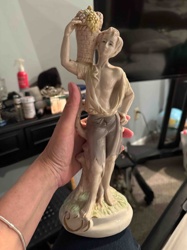
Vintage Porcelain Figural Tree Trunk Bud Vase

Decorative Arts - Ceramics and Porcelain

AI Estimated Value

·Not an official valuation·Verify before acting

$45.00 - $65.00

As of June 30, 2026

AI Item Analysis

·AI can make mistakes·Verify before acting
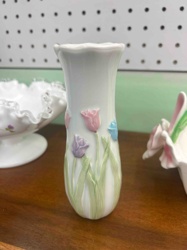
This item is a polychrome porcelain figural bud vase, likely of European or Japanese origin, dating to the mid-20th century. The piece features a young boy dressed in rustic harvest attire, including a lavender shirt, blue vest, and mustard-yellow trousers. He is holding a golden sheaf of wheat and stands adjacent to a vertically oriented bud vase modeled to resemble a weathered birch or aspen tree trunk. The tree trunk is finished in a white glaze with hand-painted textured 'bark' details accented in gold gilding. Small green molded leaves sprout from the sides of the trunk for added organic detail. The boy's face is painted in a classic style with rosy cheeks and blue eyes, suggesting a folk-art influence. The base is integrated and scalloped with gold gilt highlights along the bottom edge. In terms of condition, the gilding shows moderate rubbing and wear consistent with age, particularly along the rim of the vase and the edges of the base. There is some minor surface dirt and light crazing visible in the glaze. No major chips or cracks are immediately apparent in the primary view, though the textured nature of the 'wheat' and 'leaves' makes them prone to small fleabites. The craftsmanship is typical of mid-market decorative porcelain figurines from the 1940s-1960s, designed for mantel or shelf display.
AI Appraisal Report

·AI can make mistakes·Verify before acting
I have examined the provided description and visual characteristics of this polychrome porcelain figural bud vase. Stylistically, the piece aligns with mid-20th-century European (likely German or Italian) or Japanese 'Occupied' era decorative wares. The articulation of the 'tree trunk' and the folk-art aesthetic of the child figure are characteristic of the 1940s–1950s mass-market porcelain industry. Condition-wise, I note moderate wear to the gold gilding on the scalloped base and vase rim, which is consistent with age. While the primary glaze shows light crazing, the overall structural integrity remains intact. The complexity of the molded wheat sheaf and leaves suggests vulnerability to 'fleabite' chips, though none are acutely visible in the primary view. The market for mid-century figural porcelain of this type is currently soft, as these items were produced in high volumes for the giftware market. Value is primarily driven by decorative appeal rather than rarity or a specific maker’s mark (which appears absent or obscured). Similar 'Piano Baby' or rustic-themed bud vases frequently realize $30–$80 at auction or specialized vintage retail. Important Limitations: This appraisal is based solely on digital representation. To definitively determine authenticity and origin, an in-person examination is required to inspect for a maker's mark or backstamp on the underside of the base. Physical inspection would also permit a UV light test to check for professional over-painting or repairs not visible in standard light, and a tactile assessment of the porcelain paste and glaze weight to differentiate between European hard-paste and Japanese export porcelain. No formal provenance was provided to influence value.

Get your items appraised

Instant estimates of your treasures with AI-powered appraisals

Browse More Appraisals