AI estimate as of September 14, 2025 · verify with a professional before acting
AI-Generated · Verify before acting
Everything on this page is generated by AI for informational purposes only. AI can make mistakes — the AI may misidentify items or misattribute them (artist, maker, brand, designer, origin, era). This is not an official valuation and should not be used for insurance, sale, tax, estate, legal, or lending purposes — or any decision requiring a certified appraisal. It is not an authoritative claim about any person, brand, or rights holder — do not share or rely on it as a factual statement about a third party. Always consult qualified professionals before making financial decisions.
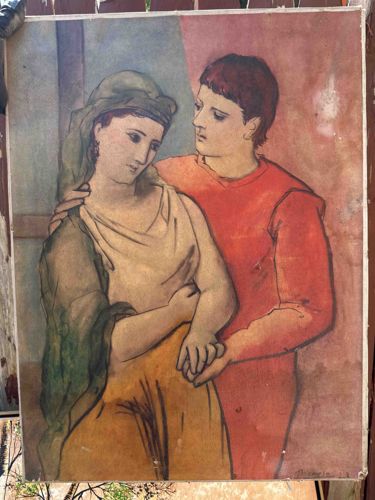
This item is a large-format reproduction print, likely on canvas or textured paper mounted on board, of Pablo Picasso's renowned 'Deux Femmes' (Two Women), also known as 'The Two Sisters' or 'The Farewell' from his Rose Period in 1904. The print depicts two figures, a woman with a green head covering and pale yellow drapery, and a younger figure (possibly a boy or another woman) in a reddish-orange tunic, with their arms around each other, holding hands. The color palette employed in this reproduction includes muted tones typical of Picasso's Rose Period, with dominant shades of ochre, green, and a warm reddish-orange. The background is divided into sections of muted blue-gray on the left and a reddish-brown on the right. Visible physical characteristics include a textured surface, suggesting a canvas print or a print with a canvas-like finish. The print appears to be mounted on a rigid backing, possibly wood or thick cardboard, as indicated by the stiff, unframed appearance. There are noticeable signs of wear and age, including scratches and scuff marks across the surface, particularly visible on the reddish background section. Discoloration, possibly from sun exposure or environmental factors, is also evident, contributing to a faded aesthetic. The corners and edges show minor abrasions. There is a faint, almost illegible signature or inscription in the bottom right corner, characteristic of Picasso's signature style or a reproduction credit. The quality of the reproduction suggests it is a commercial print, rather than an original artwork. The style is distinctly early 20th-century avant-garde, specifically aligned with Picasso's Rose Period, characterized by its melancholic mood, tender subjects, and warm color palette.
AI Appraisal Report
Based on my visual examination of the provided image, this item is a large-format reproduction print of Pablo Picasso's 'Deux Femmes' from his Rose Period. The textured surface and the apparent mounting on a rigid backing indicate it is likely a canvas print or a print with a canvas-like finish, rather than an original artwork or a fine art limited edition print. The visible wear, including scratches, scuff marks, and discoloration, suggests significant age and environmental exposure. The faded aesthetic further reinforces its status as a commercial reproduction that has experienced typical wear and tear over time. The faint, almost illegible signature in the bottom right corner is likely a reproduction credit rather than an original Picasso signature, given the item's obvious print characteristics.
Authenticity: I can definitively state that this is a reproduction print and not an original Picasso artwork. The nature of the production (textured print, mounted) and the visible signs of commercial reproduction make this clear. A thorough authentication of an original Picasso piece would require in-person examination, highly detailed documentation of provenance, and scientific analysis of pigments and materials, none of which are applicable here.
Market Conditions & Demand: Commercial reproductions of famous artworks like Picasso's 'Deux Femmes' are readily available on the market through various retailers, both new and secondhand. While Picasso's original works are highly sought after, reproductions like this do not hold significant collectible value. Demand is generally low unless purchased for decorative purposes. The condition, with noticeable wear and fading, would reduce its desirability even as a decorative item.
Factors Impacting Value: The primary factors impacting value here are its status as a mass-produced reproduction, its fair/poor condition due to wear and discoloration, and the lack of any unique or limited-edition characteristics. Its potential value is purely decorative.
Conclusion: Given its nature as a worn commercial reproduction, I appraise this item to be in the range of $50-$150. This range reflects its decorative appeal to someone seeking a large Picasso print on a budget, despite its condition, rather than any intrinsic artistic or collectible value.