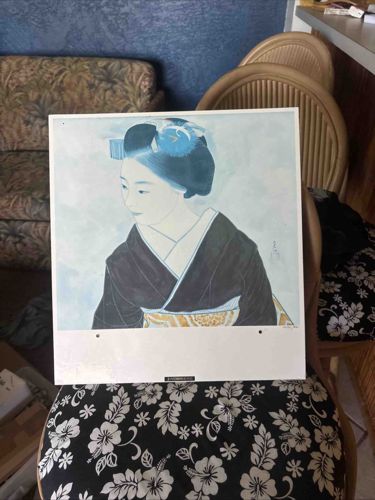
Jodai Insatsu Kabushikigaisha), indicating this is a commercial reproduction.
These notes were written by the person who submitted this item. Appraiser.AI has not verified them, and the AI's identification and estimate may rely on them.
AI Estimated Value
Not an official valuation
$10 - $30
AI estimate as of December 14, 2025 · verify with a professional before acting
AI-Generated · Verify before acting
Everything on this page is generated by AI for informational purposes only. AI can make mistakes — the AI may misidentify items or misattribute them (artist, maker, brand, designer, origin, era). This is not an official valuation and should not be used for insurance, sale, tax, estate, legal, or lending purposes — or any decision requiring a certified appraisal. It is not an authoritative claim about any person, brand, or rights holder — do not share or rely on it as a factual statement about a third party. Always consult qualified professionals before making financial decisions.
This analysis also relies on unverified notes provided by the user, which may be incomplete or inaccurate and could affect the result.
This item is a Japanese portrait print, specifically a commercial reproduction featuring a woman, likely a geisha or maiko, in traditional attire. The print depicts a soft-faced woman with her hair styled in an elaborate bun adorned with a blue hair accessory, possibly a kanzashi. Her skin tone is rendered in a very light, almost alabaster hue, with delicate facial features. She is dressed in a dark kimono, possibly black or a very deep indigo, with a distinct white collar visible underneath. Around her waist, a vibrant obi or sash in shades of gold and yellow with subtle patterning is visible. The background is a muted, light blue, suggesting a cloudy sky or a soft, undefined space. The overall color palette is somewhat cool, with the blues dominating.
The print is presented on what appears to be a stiff, white board or cardstock, indicating it is likely a mounted reproduction rather than a traditional paper print. There are two small, dark circular markings visible on the white border below the image, which could be small holes, perhaps from a previous display method. The bottom edge of the white border has a small rectangular mark with text, which, as per the additional context, indicates 'Jodai Insatsu Kabushikigaisha,' confirming its commercial reproduction status. The absence of visible brushstrokes or textures suggests a photographic or digital printing process rather than an original painting or a traditional woodblock print. The style is reminiscent of Japanese bijin-ga (pictures of beautiful women) from the Shin-hanga or Nihonga periods, likely late 19th to mid-20th century, though as a reproduction, its actual age would be significantly more recent.
AI Appraisal Report
I have examined the provided image of what appears to be a Japanese Geisha or Maiko portrait print. Based on my visual assessment and the additional context, this item is unequivocally a commercial reproduction. The crispness of the lines, lack of visible brushstrokes or paper texture, and the presence of a commercial publisher's mark ('Jodai Insatsu Kabushikigaisha') confirm it was produced using modern printing techniques. The print is mounted on what looks like stiff white board or cardstock, indicating a format common for decorative reproductions. Condition appears good for a reproduction, with minor circular markings on the border possibly from previous display.
Authenticity: As a reproduction, its authenticity as an original artwork is nil. It is a commercial print of an artwork, not the artwork itself.
Market Conditions & Comparables: The market for commercial reproductions of Japanese art, particularly those from unestablished publishers like 'Jodai Insatsu Kabushikigaisha,' is generally low. There is a vast supply of similar decorative prints available through various online platforms, thrift stores, and general merchandise retailers. Prices for such items typically range from nominal amounts to a few tens of dollars.
Demand & Rarity: There is no rarity associated with a commercial reproduction. Demand exists primarily for decorative purposes rather than as collectible art.
Factors Impacting Value: The primary factor impacting its value is its status as a reproduction. While the aesthetic appeal of the original artwork it depicts is undeniable, its commercial print form severely limits its monetary worth. Minor signs of wear, such as the circular markings, further detract from its decorative value.
Limitations: Without physical inspection, I cannot confirm the exact printing method (e.g., offset lithography, digital print), paper/board quality, or the precise nature of the circular markings. However, these details would not significantly alter the appraisal of a commercial reproduction. Provenance documentation for a reproduction is irrelevant, and scientific testing is unnecessary as it is confirmed to be a modern print.