These notes were written by the person who submitted this item. Appraiser.AI has not verified them, and the AI's identification and estimate may rely on them.
AI Estimated Value
Not an official valuation
$250-$400
AI estimate as of July 18, 2025 · verify with a professional before acting
AI-Generated · Verify before acting
Everything on this page is generated by AI for informational purposes only. AI can make mistakes — the AI may misidentify items or misattribute them (artist, maker, brand, designer, origin, era). This is not an official valuation and should not be used for insurance, sale, tax, estate, legal, or lending purposes — or any decision requiring a certified appraisal. It is not an authoritative claim about any person, brand, or rights holder — do not share or rely on it as a factual statement about a third party. Always consult qualified professionals before making financial decisions.
This analysis also relies on unverified notes provided by the user, which may be incomplete or inaccurate and could affect the result.
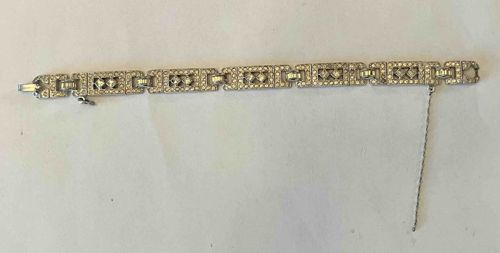
This is a vintage Art Deco-style tennis bracelet, likely dating from the 1920s to 1940s, given its geometric design and use of small, faceted stones. The bracelet is constructed of a silver-toned metal, possibly rhodium-plated brass or white gold given its reflective surface and age appropriateness for fine costume or semi-fine jewelry. It consists of multiple rectangular links, each uniformly sized and interconnected to form a flexible band. Each link features an intricate, openwork filigree design with a central arrangement of four small, clear, round faceted stones, possibly rhinestones or paste, set in a square motif. The edges of each rectangular link are also encrusted with rows of similar small, clear stones, creating a highly brilliant and shimmering effect. The overall construction appears sturdy, suggesting good craftsmanship for its era. The clasp is a tongue-and-groove type, which is secure, and it includes an additional safety chain for added security, visible on the right side of the image. "E.B." is stamped on the back of the clasp, indicating a potential maker's mark or designer's initial. The stones show minimal signs of yellowing or dullness from age, indicating either good preservation or high-quality faceted glass. There are no immediately apparent missing stones or significant damage, though a more detailed inspection would be needed to confirm the condition of individual settings. The metal appears to have a consistent patina with no obvious plating loss visible in the image. The linear arrangement and dazzling stone coverage are characteristic of the 'tennis' bracelet style, although this particular design offers a more ornate and period-specific aesthetic than modern tennis bracelets.
AI Appraisal Report
Upon my virtual examination of this Art Deco Rhinestone Tennis Bracelet, I can assess its condition and potential value. The craftsmanship, evident in the intricate openwork filigree and consistent stone setting, appears to be of good quality for its era. The stones, likely rhinestones or paste, show good preservation with minimal yellowing, indicating either careful storage or superior material quality. The silver-toned metal, possibly rhodium-plated brass or white gold, maintains a consistent patina with no visible plating loss. The secure tongue-and-groove clasp with an additional safety chain is a positive indicator of original intent for durability. The 'E.B.' stamp on the clasp suggests a maker's mark, which could potentially increase value if the maker is identifiable and reputable, though without further research or context, its specific impact is limited.
Regarding authentication, while the design and construction strongly align with the Art Deco period (1920s-1940s), a definitive authentication of materials (e.g., distinguishing rhinestones from paste, or specific metal composition) cannot be made from images alone. A physical inspection would allow for direct examination of stone faceting, brilliance, and setting security under magnification. Additionally, an in-person analysis could determine the exact metal composition through non-invasive testing. For full authentication and historical verification, delving into maker's marks databases for 'E.B.' would be crucial to determine if it's a known designer or manufacturer.
Market conditions for vintage costume jewelry are steady, with a particular interest in well-preserved Art Deco pieces. Comparables, based on similar high-quality rhinestone tennis bracelets from the period, suggest a moderate demand. The piece’s excellent visual condition and classic design contribute positively to its appeal. Without a confirmed maker or precious metal content, its rarity is limited to its age and condition rather than intrinsic material value.
Factors significantly impacting value include its excellent visual condition, the secure clasp with safety chain, and the intactness of all visible stones. A confirmed maker 'E.B.' could potentially elevate its value. Conversely, an eventual discovery of hidden damage, plating loss not visible in the image, or deterioration of stone settings would reduce its worth.
My primary limitation in this appraisal is the lack of physical examination, which precludes definitive material identification, precise condition assessment of individual settings, and full authentication of the 'E.B.' mark. Therefore, this appraisal is based on the visual information provided.