These notes were written by the person who submitted this item. Appraiser.AI has not verified them, and the AI's identification and estimate may rely on them.
AI Estimated Value
Not an official valuation
$50 - $100
AI estimate as of August 30, 2025 · verify with a professional before acting
AI-Generated · Verify before acting
Everything on this page is generated by AI for informational purposes only. AI can make mistakes — the AI may misidentify items or misattribute them (artist, maker, brand, designer, origin, era). This is not an official valuation and should not be used for insurance, sale, tax, estate, legal, or lending purposes — or any decision requiring a certified appraisal. It is not an authoritative claim about any person, brand, or rights holder — do not share or rely on it as a factual statement about a third party. Always consult qualified professionals before making financial decisions.
This analysis also relies on unverified notes provided by the user, which may be incomplete or inaccurate and could affect the result.
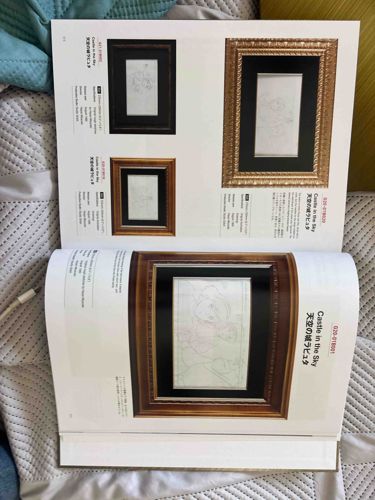
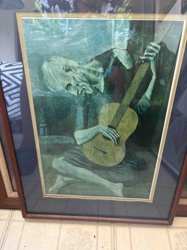
This is a catalog page showcasing various reproduction prints, likely art cels or production sketches, from the animated film 'Castle in the Sky' (天空の城ラピュタ). The page displays three distinct framed prints, each with different frame styles and sizes, suggesting a range of product offerings. The largest print on the right features a gold-toned, ornate frame with visible decorative molding, holding what appears to be a light-toned sketch or cel depicting characters or scenes from the movie, matted within a dark, possibly black, border. Below this large print is a section of Japanese text, presumably providing details about the print, such as its dimensions, materials, and price. The leftmost column of the page presents two smaller framed prints. The upper one has a dark, simple frame, while the lower one has a medium-brown, wood-toned frame, both enclosing similar-looking light-toned sketches. The visible text on the page 'Castle in the Sky' confirms the subject matter. The page itself is white with crisp edges and minimal signs of wear, indicating a well-preserved catalog. The overall presentation suggests a high-quality reproduction collection for fans or collectors of the film. No maker's marks or signatures are directly visible on the prints themselves, but the catalog format implies official merchandise. The style period is contemporary, associated with merchandise from well-known animation studios, likely post-2000 given the clear print quality and catalog design.
AI Appraisal Report
I have examined the provided image of the catalog page featuring 'Castle in the Sky' reproduction prints. Visually, the catalog page appears to be in excellent condition, with crisp edges and no visible signs of wear or damage. This indicates good preservation of the marketing material itself. Authenticity of the *prints* depicted cannot be fully verified from this image alone; this is a catalog *page*, not the prints themselves. However, the professional presentation implies official merchandise, likely from Studio Ghibli or a licensed distributor.
Market conditions for anime reproduction prints vary widely. Official, limited-edition art cels or genga (original production drawings) from beloved films like 'Castle in the Sky' can command significant values. However, these are catalog *reproductions*, which are typically mass-produced. Their value is generally lower than original production art but higher than common posters. Demand for Studio Ghibli merchandise, particularly for iconic films, remains consistently strong. Rarity is low for catalog pages and generally moderate for such reproductions, unless they are part of a very limited edition.
Factors impacting value include the 'Castle in the Sky' licensing, the visual appeal of the specific prints shown, and the catalog's condition. The value I've assigned is for the *catalog page* itself as a collectible, which is relatively low compared to the actual art prints it advertises.
Limitations: Without physical inspection of the actual prints, I cannot verify their authenticity as official reproductions, their specific edition numbers (if any), materials, or true condition. For full authentication of the prints themselves, one would need to inspect physical hallmarks, production numbers, certificates of authenticity, and ideally, original purchase provenance. For the catalog page, in-person examination would confirm paper quality, printing method, and subtle signs of age or handling not visible in the image.