AI Appraisal Estimate

AI-generated estimates · not official valuations

From the user

What was submitted

Photo and notes provided by the user — not generated by AI

Submitted item photo
Submitted photo · June 14, 2026

User's notes

No additional notes provided.

AI analysis below

AI appraisal

AI analysis & estimate

AI-Generated · Verify before acting

Everything below is generated by AI for informational purposes only. AI can make mistakes — the AI may misidentify items or misattribute them (artist, maker, brand, designer, origin, era). This is not an official valuation and should not be used for insurance, sale, tax, estate, legal, or lending purposes — or any decision requiring a certified appraisal. It is not an authoritative claim about any person, brand, or rights holder — do not share or rely on it as a factual statement about a third party. Always consult qualified professionals before making financial decisions.

Read the full disclaimer

AI Identification

·Not independently authenticated·Verify before acting

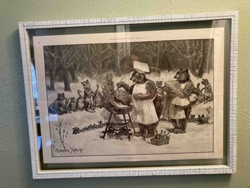
Phiz Illustration for 'The Pickwick Papers' by Charles Dickens

Fine Art Prints / 19th Century Book Illustrations

AI Estimated Value

·Not an official valuation·Verify before acting

$45.00 - $75.00

As of June 14, 2026

AI Item Analysis

·AI can make mistakes·Verify before acting
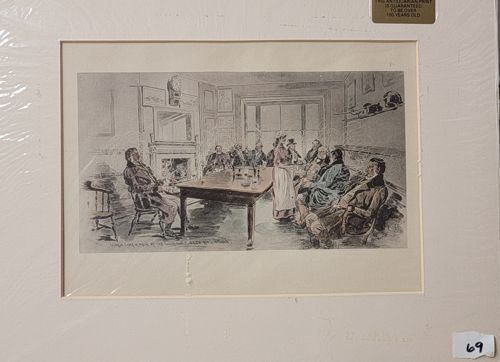
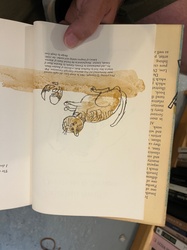
This item is an antique hand-colored steel engraving or etching, typically known as a 'Phiz' illustration, created for a 19th-century publication of Charles Dickens' 'The Pickwick Papers'. The scene depicts a lively gathering or assembly in a tavern-like interior setting, characteristic of the Victorian narrative art style. The print is rendered on paper and features delicate watercolor tints applied over the black-and-white etched lines to add dimension to the characters' clothing and the environmental details. It is mounted within a cream-colored window mat, which is currently protected by original plastic shrink-wrap. A gold foil sticker in the upper right corner of the matting guarantees the antiquity of the print, stating it is 'guaranteed to be over 100 years old.' The artwork shows signs of its significant age, including notable foxing (brown spotting) primarily visible in the lower-center margin of the print paper, as well as minor paper undulation. The drafting reveals the high-quality, expressive caricaturization typical of Hablot Knight Browne ('Phiz'), with fine line work depicting textures like wood grain and fireplace smoke. The overall condition is fair to good for its age, noting the visible oxidative spots on the primary paper surface. This piece likely dates to the mid-to-late 19th century.
AI Appraisal Report

·AI can make mistakes·Verify before acting
I have virtually examined this hand-colored etching by Hablot Knight Browne, famously known as 'Phiz,' created for Charles Dickens' 'The Pickwick Papers.' This specific plate exhibits the signature Victorian caricature style that defined Dickensian visual culture. Based on the visual evidence, the print appears to be an authentic 19th-century steel engraving, likely extracted from an early subsequent edition rather than the 1836-37 serial parts, given the later application of watercolor tints. The presence of 'foxing' (brown fungal spotting) in the lower margin and minor undulation are consistent with the natural aging process of 19th-century wood-pulp or rag paper. While the 'guaranteed over 100 years old' sticker suggests a provenance from mid-20th-century antique trade, it acts as a commercial mark rather than a scholarly certificate. Market demand for isolated 'Phiz' plates is currently stable but modest; they are prolific due to the massive print runs of Dickens' works. Significant value inhibitors here include the visible foxing—which necessitates professional conservation to prevent further degradation—and the fact that the piece is likely a common plate rather than a rare 'suppressed' image. Authentication via digital image is preliminary. A physical inspection is required to check for the presence of a 'plate mark,' evaluate the paper's watermark, and confirm the medium (engraving vs. a later photo-mechanical reproduction). The watercolor depth must also be examined under a loupe to ensure it is period-correct hand-tinting rather than modern offset coloring. Full verification would ideally include provenance from a known bibliographical collection or original book binding coordinates.

Get your items appraised

Instant estimates of your treasures with AI-powered appraisals

Browse More Appraisals