AI estimate as of October 28, 2025 · verify with a professional before acting
AI-Generated · Verify before acting
Everything on this page is generated by AI for informational purposes only. AI can make mistakes — the AI may misidentify items or misattribute them (artist, maker, brand, designer, origin, era). This is not an official valuation and should not be used for insurance, sale, tax, estate, legal, or lending purposes — or any decision requiring a certified appraisal. It is not an authoritative claim about any person, brand, or rights holder — do not share or rely on it as a factual statement about a third party. Always consult qualified professionals before making financial decisions.
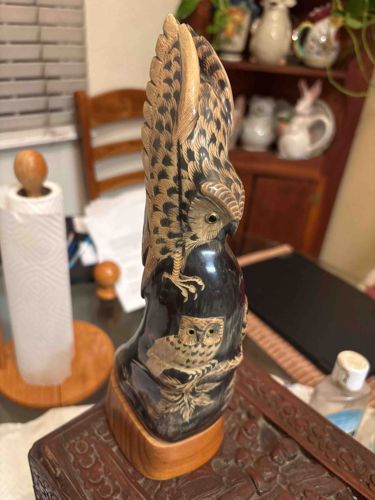
This appears to be a decorative sculpture, likely crafted from a carved animal horn, possibly buffalo horn, mounted on a wooden base. The primary material, the horn, exhibits a deep, dark brown to black color with a smooth, polished finish. The carving technique involves relief and incised details, where lighter-colored areas (presumably the inner horn material or a contrasting layer) are exposed to create the imagery. The central motif is a large owl, depicted with intricate feather details on its wings and body, and prominent eyes. Its large, outstretched wings show individual feathers with dark tips on a lighter tan or ivory-colored base. Below the large owl, on the dark body of the horn, a smaller owl is carved perched on a branch with leaves, mirroring the detailed craftsmanship of the larger bird. The base is made of a light-colored, possibly stained, wood with a smooth finish, providing a stable foundation for the sculpture. The overall condition appears good, with no immediately visible cracks, chips, or significant damage to the horn or the carvings. There might be some minor surface wear consistent with handling and age, possibly a slight loss of luster in some areas, but no major condition issues are apparent. The craftsmanship suggests a skilled artisan, with fine details and a strong sense of avian anatomy. This piece likely dates from the mid-to-late 20th century or more recently, and its style is often associated with Asian decorative arts, particularly those from Southeast Asia, where horn carving is a traditional art form. The contrast between the dark horn and the light carved details is particularly striking, highlighting the intricate work. The eyes of the large owl appear to be inlaid, likely with glass or a similar material, adding a lifelike quality. No obvious maker's marks or signatures are discernible from the provided images.
AI Appraisal Report
Based on my visual examination of the provided image, this Carved Owl Horn Sculpture appears to be in good overall condition. The horn exhibits a smooth, polished finish with intricate relief and incised details. I see no immediate cracks, chips, or significant damage to the horn or the carvings. The contrast between the dark horn and lighter carved details, particularly the individual feathers and the two owls, is striking. The large owl's inlaid eyes add a lifelike quality. The light-colored wooden base also appears smooth and intact. As an appraiser, I must note that this assessment is limited to visual inspection from an image; an in-person examination would be crucial to confirm the absence of subtle hairline cracks, minor abrasions, repairs, or the exact material of the inlaid eyes. Provenance documentation could further verify its origin and age, and without it, authenticity as an antique traditional piece versus a more recent decorative item remains an assumption.
This style of horn carving, often depicting animal scenes with intricate detail and natural material contrast, is commonly associated with Asian decorative arts, particularly from regions like Southeast Asia. Similar pieces, carved from buffalo or ox horn, regularly appear in the market. While the craftsmanship is good, the general market for decorative horn carvings, especially those from the mid-to-late 20th century or later, is moderate rather than high. Demand exists for well-executed pieces, but rarity is not a significant factor unless tied to a known master artisan or specific historical significance, neither of which is indicated here. Factors impacting value include the quality of the carving, the condition of the horn, and the overall artistic appeal. Without a definitive artist or documented history, the value is primarily decorative. This piece would appeal to collectors of avian-themed decor or specific Asian decorative arts. While undoubtedly decorative and well-made, it doesn't present characteristics that would place it in a higher echelon of collector items.