AI estimate as of July 4, 2025 · verify with a professional before acting
AI-Generated · Verify before acting
Everything on this page is generated by AI for informational purposes only. AI can make mistakes — the AI may misidentify items or misattribute them (artist, maker, brand, designer, origin, era). This is not an official valuation and should not be used for insurance, sale, tax, estate, legal, or lending purposes — or any decision requiring a certified appraisal. It is not an authoritative claim about any person, brand, or rights holder — do not share or rely on it as a factual statement about a third party. Always consult qualified professionals before making financial decisions.
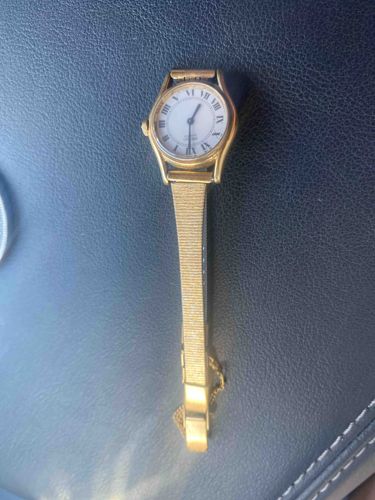
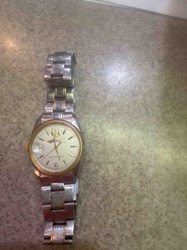
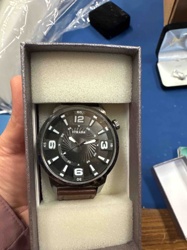
This is a vintage-style ladies' wristwatch, characterized by its golden-toned metal construction. The watch features a relatively small, oval or slightly octagonal case enclosing a white or off-white dial. The dial is marked with black Roman numerals for hour indicators, offering a classic and elegant aesthetic. The minute and hour hands appear to be black or dark-colored, providing good contrast against the light dial. There is a prominent 'SWISS MADE' inscription visible towards the bottom of the dial, indicating its country of origin and suggesting a certain level of craftsmanship. Below the 'SWISS MADE' text, there's another line of text which is difficult to discern but might be a brand name or model number. The watch is attached to a narrow, flexible metal strap, also in a golden tone, with a patterned or mesh-like texture, commonly seen on older watches. The clasp mechanism is visible at the end of the strap, appearing to be a fold-over or box clasp with a small safety chain attached, a common feature for security on older pieces. The overall condition appears to be relatively good for its age, though some light surface wear or minor scratches might be present on the metal, consistent with normal use. The gold tone seems consistent throughout, suggesting either gold plating or a gold-colored alloy. The style points towards a manufacture date likely in the mid-to-late 20th century, possibly 1970s or 1980s, given the design of the case and strap.
AI Appraisal Report
Upon my virtual examination of this vintage gold-tone ladies' wristwatch, I can affirm its aesthetic appeal and apparent good condition for its age. The 'SWISS MADE' inscription lends credibility to its origin, suggesting a level of quality associated with Swiss horology. The Roman numeral dial, oval case, and flexible mesh-like gold-tone strap are consistent with styles prevalent in the 1970s and 1980s, placing it squarely in the mid-to-late 20th century.
From the image, the gold tone appears consistent, indicating either quality plating or a gold-colored alloy. Surface wear seems minimal, consistent with normal use, and the clasp mechanism with its safety chain adds to its intactness.
Limitations in authenticity verification are significant. Without a physical inspection, I cannot confirm the material composition (e.g., solid gold versus gold-plated base metal), the type of movement (quartz vs. mechanical), or the true condition of the internal mechanics. The indiscernible text below 'SWISS MADE' could be a key determinant of brand and value, and I cannot read it.
In terms of market conditions, vintage ladies' watches of this era, especially those that are gold-plated and not from highly sought-after luxury brands, generally occupy a modest segment of the collector's market. Demand is moderate, driven by those seeking vintage aesthetics or costume jewelry. Rarity is not a significant factor here; similar styles were mass-produced. Factors significantly impacting value would be confirmation of a solid gold case, a reputable brand, or a mechanical movement in excellent working order. Without these, it would fall into the category of a vintage fashion accessory.
For a full authentication, I would need a hands-on examination to assess the movement, test the metal composition, and thoroughly inspect for hidden damage or repairs. Provenance documentation, if available, would also be invaluable in verifying its history and potential brand.