AI estimate as of August 10, 2025 · verify with a professional before acting
AI-Generated · Verify before acting
Everything on this page is generated by AI for informational purposes only. AI can make mistakes — the AI may misidentify items or misattribute them (artist, maker, brand, designer, origin, era). This is not an official valuation and should not be used for insurance, sale, tax, estate, legal, or lending purposes — or any decision requiring a certified appraisal. It is not an authoritative claim about any person, brand, or rights holder — do not share or rely on it as a factual statement about a third party. Always consult qualified professionals before making financial decisions.
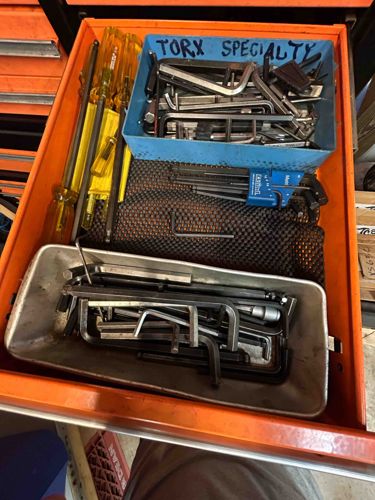
This image displays a drawer from a tool chest, primarily containing a collection of hex key wrenches and a selection of screwdrivers. The drawer itself is bright orange, suggesting a common material like painted steel or a durable polymer, and appears to be lined with a black, textured, possibly rubber or foam mat for tool organization and to prevent scratching. The hex keys are found in various sizes and finishes, predominantly metallic, with some showing a blackened or matte finish suggesting carbon steel, while others are brighter, likely chrome-plated or stainless steel. One blue plastic organizer, manually labeled "TORX SPECIALTY" with a marker, contains an assortment of Torx-head hex keys, emphasizing their specialized nature. Another larger, rectangular metal tray, likely aluminum or galvanized steel, holds a looser collection of standard hex keys, some exhibiting oil residue and minor surface wear consistent with regular use. A blue, plastic holder with a clip-fastening mechanism, possibly for holding a set of folding hex keys, is also visible. Alongside the hex keys, several screwdrivers with translucent yellow or amber handles are present, varying in shaft length and tip type, though the exact tip types (Phillips, flathead, etc.) are not clearly discernible. The tools collectively show signs of moderate use and age, including minor scratches, scuffs, and some dust accumulation, but no significant damage or rust is evident, indicating they are in good working condition. The overall impression is a well-maintained, user-organized collection of common professional or hobbyist hand tools.
AI Appraisal Report
Upon visual examination of the provided image, I assess this collection of assorted hex key wrenches and screwdrivers, housed within an orange tool drawer, to be in good working condition. The tools exhibit typical signs of moderate use and age, such as minor scratches, scuffs, and some dust accumulation, but critically, I observe no significant damage or active rust. This suggests they have been reasonably well-maintained. The orange drawer, likely steel or durable polymer, and the black textured lining contribute to a functional storage solution.
Authenticity, based solely on this image, is limited. These appear to be common, mass-produced hand tools, and there are no visible brand markings that would allow for specific authentication of manufacturer or origin. The "TORX SPECIALTY" label is hand-written, indicating user organization rather than a factory label. Without physical inspection, I cannot confirm the material composition beyond visual assumptions (e.g., carbon steel, chrome-plated), nor can I assess the quality of the tool steel, handle durability, or the precise condition of tool tips.
In terms of market conditions, common hex key sets and screwdrivers are readily available new from numerous manufacturers at various price points. This collection is used, which significantly impacts its value compared to new items. Comparables would include used tool lots sold at garage sales, online marketplaces, or local auctions. There is no inherent rarity to these types of tools; they are standard professional or hobbyist equipment. Demand is consistent for functional tools, but this specific assortment does not present any unique or highly sought-after items.
Factors significantly impacting value include the used condition, the lack of discernible premium brands, and the general availability of such items. The organization provided by the drawer and liner adds some marginal value for a buyer seeking a ready-to-use setup, but it’s still subordinate to the tools themselves.
For full authentication and a more precise valuation, I would require a physical examination to inspect individual tool brands, assess material quality, check for wear on specific tips (e.g., Phillips, flathead, hex faces), and test functionality. Provenance documentation (e.g., original purchase receipts) would be helpful if specific brands or high-end tools were identifiable, but for this collection, it's less critical. Scientific testing, such as metallurgy analysis, would be entirely unwarranted given the nature and likely value of these common hand tools.