These notes were written by the person who submitted this item. Appraiser.AI has not verified them, and the AI's identification and estimate may rely on them.
AI Estimated Value
Not an official valuation
$100-175
AI estimate as of July 17, 2025 · verify with a professional before acting
AI-Generated · Verify before acting
Everything on this page is generated by AI for informational purposes only. AI can make mistakes — the AI may misidentify items or misattribute them (artist, maker, brand, designer, origin, era). This is not an official valuation and should not be used for insurance, sale, tax, estate, legal, or lending purposes — or any decision requiring a certified appraisal. It is not an authoritative claim about any person, brand, or rights holder — do not share or rely on it as a factual statement about a third party. Always consult qualified professionals before making financial decisions.
This analysis also relies on unverified notes provided by the user, which may be incomplete or inaccurate and could affect the result.
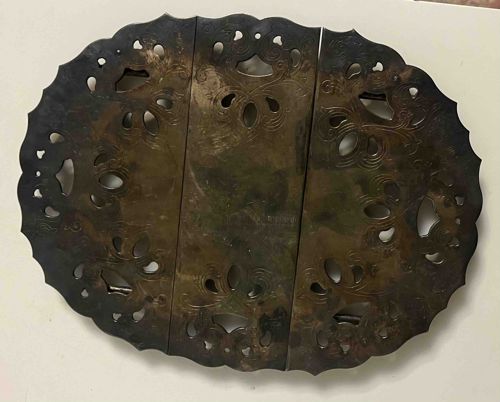
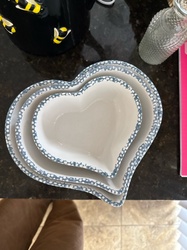
This item is an oval-shaped, extendable trivet, likely crafted from a metal alloy such as brass or a copper-based metal, given its dark, oxidized patina with greenish and brown undertones. It consists of three distinct segments, hinged together, allowing it to expand or contract. The surface is elaborately decorated with a complex, openwork design featuring floral and scroll motifs, created using cut-outs and etched or embossed details. The edges of the trivet are scalloped, adding to its decorative appeal. The overall color is a deep, tarnished bronze, indicating significant age and lack of recent polishing, a condition often referred to as a natural patination. There are visible signs of wear, including scratches and scuffs on the flat surfaces, consistent with utilitarian use over time. Some areas of the metal appear brighter where the patina may have been rubbed away, suggesting areas of contact or handling. The craftsmanship appears to be of good quality, with precise cuts for the intricate designs. While no explicit maker's marks or signatures are visible in the provided image, the style of the scrollwork and the construction suggest a late 19th to early 20th century aesthetic, possibly Art Nouveau or Victorian era when such decorative household items were popular. The extendable nature is a key functional feature, allowing it to accommodate various sizes of hot dishes. The visible oxidation and surface irregularities contribute to its antique character, rather than being considered significant damage.
AI Appraisal Report
Based on my visual examination of the provided image, this Victorian/Edwardian extendable metal trivet appears to be a genuine piece from the late 19th to early 20th century. The dark, oxidized patina with greenish/brown undertones strongly suggests a copper or brass alloy, consistent with the period techniques and materials for such decorative utilitarian items. The intricate openwork floral and scroll motifs are characteristic of the Victorian or early Art Nouveau aesthetic. Its extendable, hinged design is a classic functional feature for trivets of this era.
The condition, while showing scratches and scuffs, is typical for an item of this age that saw regular use. The natural patination, rather than being a flaw, enhances its antique character and is preferable to over-polishing, which can diminish value. Brighter areas where patina has rubbed away are normal indicators of handling.
In terms of market conditions, such domestic antique items generally have a consistent but not exceptionally high demand. Comparables in similar online antique marketplaces and auction records suggest that decorative and functional pieces like this range widely based on material, intricacy, and most importantly, specific provenance or maker's marks. Without a visible maker's mark, its value relies heavily on its decorative appeal and authentic age.
The demand for general antique kitchenware/tableware is moderate, with rarity depending on the specific design and condition. This trivet’s design is appealing but not uniquely rare in the broader market of period trivets. Its extendable nature does add a practical and interesting feature.
Factors significantly impacting value include the lack of a known maker, which prevents it from reaching the higher echelons of collector's items. Its solid condition for its age and appealing aesthetic contribute positively.
Limitations in authenticity verification from images alone are crucial here. To fully authenticate and assess, an in-person examination would be necessary to:
1. Confirm the exact metal composition through non-invasive testing.
2. Thoroughly inspect all hinges and joints for repairs or modifications not visible in the image.
3. Search for any hidden or faint maker's marks, impressions, or dates.
4. Assess the precise tactile quality and weight, which can help confirm material and age.
Provenance documentation, such as original purchase receipts or family heirlooms records, if available, would significantly enhance its value.