AI estimate as of November 10, 2025 · verify with a professional before acting
AI-Generated · Verify before acting
Everything on this page is generated by AI for informational purposes only. AI can make mistakes — the AI may misidentify items or misattribute them (artist, maker, brand, designer, origin, era). This is not an official valuation and should not be used for insurance, sale, tax, estate, legal, or lending purposes — or any decision requiring a certified appraisal. It is not an authoritative claim about any person, brand, or rights holder — do not share or rely on it as a factual statement about a third party. Always consult qualified professionals before making financial decisions.
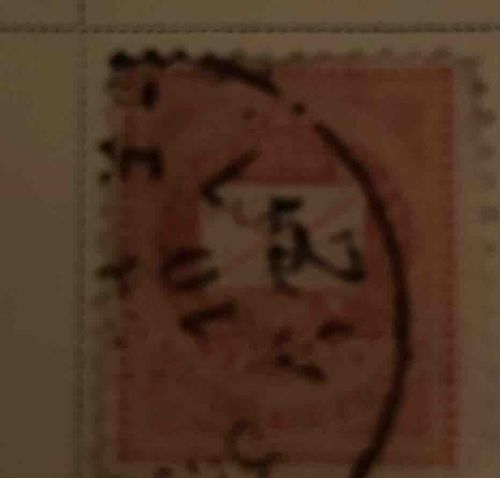
The item is a small, rectangular postage stamp, likely made of paper, exhibiting a reddish-brown or ochre primary color, possibly faded or discolored over time. It features a perforated edge, indicating it was separated from a sheet of similar stamps. The overall size appears to be standard for a postage stamp of its era, though exact dimensions cannot be determined from the image. The stamp displays several dark, possibly black or very dark ink, markings. Most prominently, there is a large, circular or oval cancellation mark that partially covers the stamp, indicating postal use. Within this cancellation, or perhaps as part of the original stamp design, there are discernible alphanumeric characters. On the left side, rotated approximately 90 degrees clockwise, appear to be characters 'E' and 'L' followed by '10'. On the right side, there are more intricate, possibly calligraphic or stylized characters, which are difficult to decipher fully but resemble Asian or Middle Eastern script. The quality of the print on the stamp itself, beneath the cancellation, appears somewhat coarse, suggesting an older printing technology. The condition exhibits significant wear, with the edges showing some fraying or handling marks, and the colors appearing muted. The cancellation mark is heavy and obscures a notable portion of the stamp's original design, which is common for used philatelic items. The visible aspects suggest it could be a postal artifact from the late 19th or early 20th century, given its aesthetic and printing characteristics. The presence of what appears to be both Roman and other script suggests a stamp issued for a territory with mixed cultural influences or an international postal item. The perceived quality of the paper and ink points to mass production during a period when philately was becoming widely established.
AI Appraisal Report
I have examined the image of this perforated postage stamp with numerical and character markings. The stamp exhibits a reddish-brown/ochre color with a perforated edge. Its apparent standard size suggests a common postal artifact. Key features include a heavy circular cancellation mark, obscuring parts of the design, and alphanumeric characters 'E', 'L', and '10' visible, along with what appears to be intricate, possibly Asian or Middle Eastern script. The coarse print quality and wear, including frayed edges, suggest an older item, likely late 19th or early 20th century. The heavy cancellation significantly impacts visibility of the original design, which generally reduces philatelic value.
Authenticity, based solely on visual examination of the image, appears consistent with a genuine used stamp of the period. However, definitive authenticity cannot be ascertained without in-person physical inspection, which would reveal details like paper type, watermarks, exact printing methods, and ink characteristics. I would also need to examine the back of the stamp for any additional markings or thins.
Market conditions for heavily cancelled, unidentified stamps are generally moderate. Comparables would include other used stamps of similar age with significant cancellations. Rarity is difficult to assess without identifying the specific stamp issue. If it proves to be a common issue, even with the intriguing script, the heavy cancellation limits its appeal to collectors. Demand for such items is typically from general collectors rather than specialist philatelists unless the underlying stamp proves to be exceptionally rare or has a unique postal history. Due to these factors, particularly the heavy cancellation and unknown identity, my estimated value is conservative.
For full authentication and a more precise valuation, a physical examination by a philatelic expert is crucial to identify the stamp, gauge its true condition, and investigate the cancellation further. Provenance documentation, if available, would also be invaluable.