These notes were written by the person who submitted this item. Appraiser.AI has not verified them, and the AI's identification and estimate may rely on them.
AI Estimated Value
Not an official valuation
$30 - $50
AI estimate as of November 10, 2025 · verify with a professional before acting
AI-Generated · Verify before acting
Everything on this page is generated by AI for informational purposes only. AI can make mistakes — the AI may misidentify items or misattribute them (artist, maker, brand, designer, origin, era). This is not an official valuation and should not be used for insurance, sale, tax, estate, legal, or lending purposes — or any decision requiring a certified appraisal. It is not an authoritative claim about any person, brand, or rights holder — do not share or rely on it as a factual statement about a third party. Always consult qualified professionals before making financial decisions.
This analysis also relies on unverified notes provided by the user, which may be incomplete or inaccurate and could affect the result.
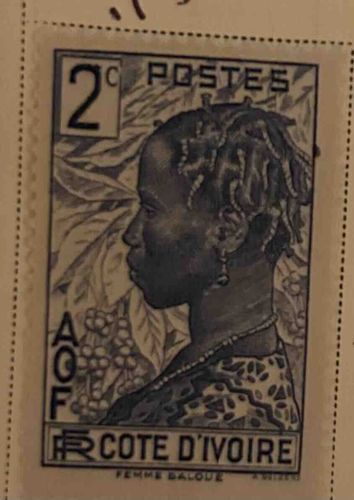
This item is a single postage stamp, likely from the French colonial era, specifically for Côte d'Ivoire (Ivory Coast) within Afrique Occidentale Française (AOF). It features a monochrome design, predominantly in shades of dark blue-grey or black ink on a lighter paper, depicting the profile of a Baoulé woman. The woman is shown facing left, with intricate dreadlocks or braided hair, and appears to be wearing an earring and a beaded necklace. Her clothing, visible on her shoulder and upper chest, features a patterned fabric. The background behind her suggests lush foliage, possibly coffee or cocoa plants, indicated by clustered berries or beans, which were significant agricultural products of the region.
The stamp's denomination '2c' (2 centimes) is prominently displayed in the top left corner. The word 'POSTES' is horizontally aligned at the top right, indicating its purpose as a postal item. Vertically aligned on the left side are the letters 'AOF', representing Afrique Occidentale Française. At the bottom, 'R CÔTE D'IVOIRE' is enclosed within a rectangular border, clearly identifying the territory of issuance. Beneath this, in smaller script, is 'FEMME BAOULE', explicitly labeling the subject of the portrait. An artist's or engraver's signature, '00TIVER', is barely legible in the bottom right corner.
The stamp exhibits standard perforations along its edges, typically used for easy separation from a sheet. The visible condition suggests it is either unused or lightly handled, with no obvious cancellations or major creases. The paper appears to be clean, and the printing registration seems accurate. The detail in the engraving points to a high level of craftsmanship for a postal issue of its time. The style points to an early to mid-20th-century colonial stamp, likely reflecting indigenous culture and natural resources as themes. The overall aesthetic is illustrative and informative, intended to convey both the value and origin of the stamp.
AI Appraisal Report
I have examined the provided image of the Côte d'Ivoire 'Femme Baoulé' 2 centimes stamp, likely from the French colonial era. Based on the visual evidence, the stamp appears to be in very fine to extremely fine uncancelled condition, exhibiting well-defined perforations and clear printing with no apparent faults like tears, creases, or thins. The centering seems good to very good, with the design relatively well-placed within the margins. The details described, such as the '2c' denomination, 'POSTES', 'AOF', 'R CÔTE D'IVOIRE', and 'FEMME BAOULE', align with known issues for this specific stamp. The signature '00TIVER' (likely 'ROUSSELOT' or a related engraver based on common issues) is also consistent.
Market analysis for this type of colonial African stamp generally places well-preserved examples in a modest price range. While older, these issues are not exceedingly rare, especially in uncancelled form, due to substantial print runs. Demand is steady among collectors specializing in French colonies or African philately. Factors impacting value positively include its excellent apparent condition and clear depiction of cultural iconography.
However, it is crucial to state that this appraisal is based solely on visual examination of the image. My assessment of condition and authenticity is limited to what can be perceived remotely. A physical in-hand examination is essential to verify authenticity conclusively, confirm the absence of hidden faults (e.g., repairs, reperforations, regumming, hinge remnants under magnification), and accurately assess the paper and gum condition. Without physical inspection, I cannot rule out the possibility of it being a highly convincing reproduction or having subtle condition issues not visible in the image. Provenance documentation, if available, would also aid in solidifying its history and authenticity.