AI estimate as of September 6, 2025 · verify with a professional before acting
AI-Generated · Verify before acting
Everything on this page is generated by AI for informational purposes only. AI can make mistakes — the AI may misidentify items or misattribute them (artist, maker, brand, designer, origin, era). This is not an official valuation and should not be used for insurance, sale, tax, estate, legal, or lending purposes — or any decision requiring a certified appraisal. It is not an authoritative claim about any person, brand, or rights holder — do not share or rely on it as a factual statement about a third party. Always consult qualified professionals before making financial decisions.
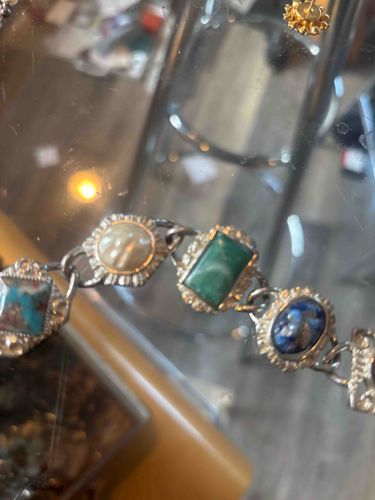
This item is a multi-panel link bracelet, likely crafted from a silver-toned metal, possibly a base metal alloy, given the slight dullness and lack of significant shine suggesting sterling silver or platinum. The bracelet consists of several distinct, bezel-set panels, each featuring a different cabochon-cut gemstone or simulated stone. Each panel is uniform in design, with a decorative, textured border, possibly a filigree or milgrain-like pattern, surrounding the central stone. The stones visible appear to include: a square-shaped stone with turquoise matrix patterning; an oval or circular stone with a creamy, possibly mother-of-pearl or faux pearl appearance; a rectangular faceted stone in a deep green hue with evident marbling, possibly malachite or a simulated green stone; and an oval-shaped stone with a deep blue color and lighter blue/grey inclusions, characteristic of lapis lazuli or a similar natural stone. The links connecting these panels are simple, likely oval or jump rings, suggesting a standard construction method for costume jewelry. The visible condition shows some signs of wear consistent with age and use, including slight dulling of the metal and minor surface scratches on the stones which is common for a vintage piece. There are no obvious signs of significant damage or repairs. The overall craftsmanship suggests a mass-produced piece typical of mid-20th-century costume jewelry, prioritizing visual appeal over precious materials. The piece lacks discernible maker's marks or signatures in the visible areas. The varied stones and linked panel construction are characteristic of pieces from the Mid-Century Modern period, likely dating from the 1940s to 1960s.
AI Appraisal Report
Based on my visual examination of the Multi-Stone Panel Link Bracelet, I assess its condition as good vintage, consistent with its likely age. The metal, appearing to be a silver-toned base metal, shows the expected dulling but no significant tarnish or plating loss. The various cabochon stones, including what appears to be turquoise, mother-of-pearl imitation, green marbled (likely malachite or simulant), and lapis lazuli, show minor surface scratches common for a worn piece, but no chips or cracks. The bezel settings and linking rings appear structurally sound. Authenticity, based on the image, suggests this is a genuine piece of mid-20th-century costume jewelry. The craftsmanship, with its repetitive panel design and varied, common semi-precious or simulated stones, aligns perfectly with mass-produced pieces from the 1940s-1960s.
Market conditions for vintage costume jewelry, especially multi-stone link bracelets from this era, are generally steady. Comparable pieces, often found in online vintage marketplaces or antique shops, typically range from $30 to $150 depending on condition, specific materials, and any designer attribution. This piece lacks discernible maker's marks, which limits its value compared to signed pieces by known costume jewelry designers. Demand for unsigned costume jewelry of this type is moderate, driven by collectors of vintage accessories and those seeking unique, affordable period pieces. Rarity is low; similar styles were widely produced.
Factors impacting value include the non-precious metals and the likely use of simulated or common semi-precious stones, which inherently limit monetary worth. The lack of a designer signature is also a key limiting factor. While it's a visually appealing piece, its decorative value far outweighs its intrinsic material value.
It is crucial to note the limitations of authenticity verification from images alone. A physical in-person examination would be necessary to definitively confirm the metal composition (e.g., non-magnetic test, acid test for silver content if suspected), and to accurately identify the gemstones. Spectroscopic analysis or a gemological examination would be required to confirm natural vs. simulated stones. Provenance documentation, if available, could also enhance its collectibility, but none is provided here.